

The rapid growth of Artificial Intelligence (AI), High-Performance Computing (HPC), cloud services, and large-scale data analytics is driving unprecedented increases in rack power density.
Traditional air-cooling technologies, which have served the data center industry for decades, are increasingly struggling to handle racks exceeding 30kW, 50kW, or even 100kW.
To address these challenges, many operators are adopting Cold Plate Liquid Cooling Solutions, also known as Direct-to-Chip Liquid Cooling Systems.
Unlike conventional air cooling, cold plate liquid cooling removes heat directly from high-power components such as CPUs and GPUs, significantly improving thermal efficiency while reducing overall energy consumption.
But what exactly makes up a complete cold plate liquid cooling solution?
In this article, we explore the key components of a modern liquid cooling architecture and explain how each element contributes to building an efficient, scalable, and AI-ready data center.
Modern AI servers generate enormous amounts of heat.
A single AI rack may contain:
● Multiple GPUs
● High-performance CPUs
● High-speed memory
● AI accelerators
These components can generate several times more heat than traditional enterprise servers.
Cold plate liquid cooling offers several advantages:
✓ Higher cooling efficiency
✓ Lower PUE
✓ Support for ultra-high-density racks
✓ Reduced fan power consumption
✓ Increased hardware reliability
✓ Improved sustainability
As a result, cold plate liquid cooling has become one of the most widely adopted cooling technologies in next-generation AI data centers.
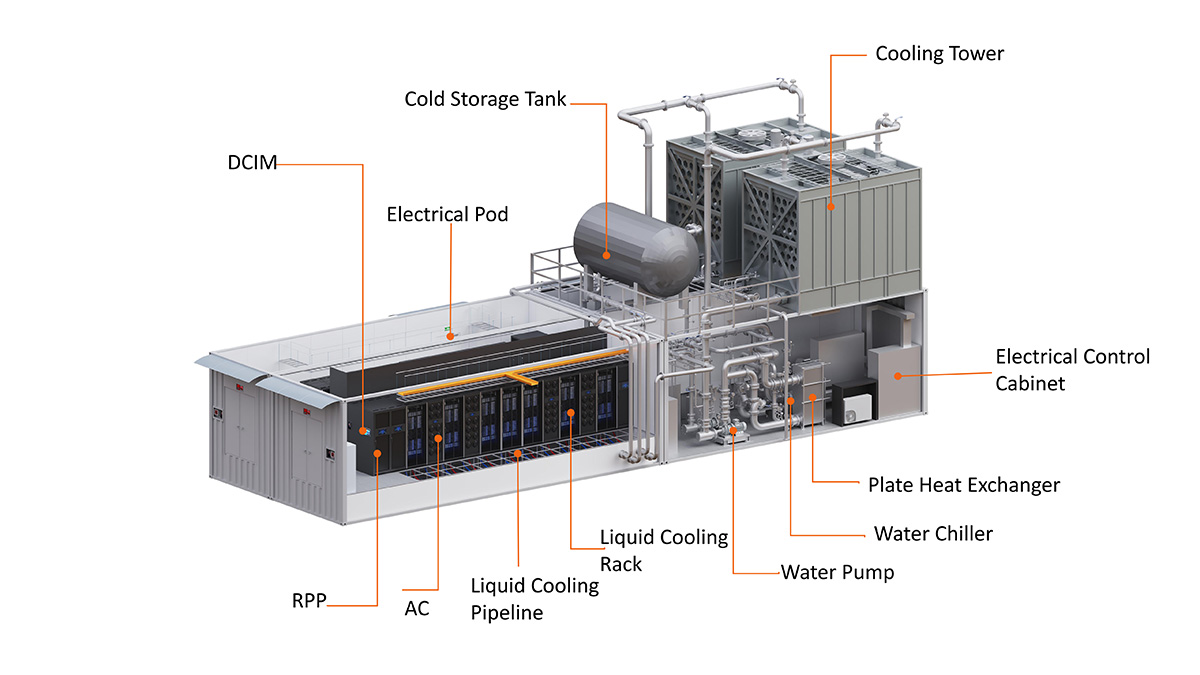
A complete liquid cooling solution can be divided into three major layers:
● Server-Side Components
● Facility-Side Infrastructure
● Intelligent Monitoring and Control System
Each layer plays a critical role in maintaining safe and efficient operation.
The server-side cooling architecture is responsible for capturing heat directly from the electronic components.
The cold plate is the heart of the liquid cooling system.
Typically manufactured from:
● Copper
● Aluminum
● Copper-alloy materials
Cold plates contain precision-engineered internal flow channels designed to maximize heat transfer efficiency.
These plates are mounted directly onto heat-generating components such as:
● CPUs
● GPUs
● AI accelerators
● High-bandwidth memory (HBM)
Thermal interface materials (TIMs), such as thermal grease or thermal pads, ensure optimal contact between the chip and the cold plate.
As coolant flows through the internal channels, heat is transferred from the chip directly into the liquid.
● Extremely high heat transfer efficiency
● Reduced chip temperatures
● Improved processor performance
● Enhanced system stability
Quick Disconnect Couplings are installed at the liquid inlet and outlet connections of the server.
These connectors allow:
● Tool-less connection
● Hot-swappable maintenance
● Leak-free disconnection
A properly designed QDC prevents coolant loss during maintenance and significantly improves serviceability.
For large AI clusters, QDC technology is essential for minimizing downtime.
Inside the server, coolant must be distributed efficiently to multiple cooling components.
This is achieved through:
● Flexible tubing
● Rigid piping
● Internal manifolds
The manifold serves as a distribution hub that:
● Delivers coolant to each cold plate
● Collects heated coolant
● Maintains balanced flow rates
Proper manifold design ensures uniform cooling performance across all components.
Safety is critical in any liquid cooling environment.
Modern liquid-cooled servers integrate sensors to monitor:
● Flow rate
● Pressure
● Coolant temperature
● Leak detection status
If abnormalities are detected, the system can immediately:
● Trigger alarms
● Adjust cooling parameters
● Initiate shutdown procedures
This significantly improves operational reliability.
Not all servers are designed for liquid cooling.
Dedicated liquid-cooled servers feature:
● Optimized chassis structures
● Specialized coolant routing
● Enhanced airflow design
● Integrated monitoring capabilities
These systems are specifically engineered for AI, HPC, and high-density computing environments.
While server-side components collect heat, facility-side infrastructure removes that heat from the data center.
The CDU is often considered the central hub of the liquid cooling system.
It acts as the interface between:
● Building cooling infrastructure
● Server cooling loops
A CDU typically contains:
● Pumps
● Plate heat exchangers
● Expansion tanks
● Filters
● Valves
● Sensors
● Control systems
Its primary function is to:
● Deliver coolant to the racks
● Collect heated return liquid
● Maintain proper pressure and flow
CDUs can be deployed as:
Installed within or adjacent to individual racks.
Serving multiple racks or entire liquid cooling zones.
Flow control valves regulate coolant delivery based on real-time thermal demand.
Benefits include:
● Precise cooling control
● Reduced pump energy consumption
● Improved temperature stability
Smart valves enable dynamic cooling optimization for varying IT workloads.
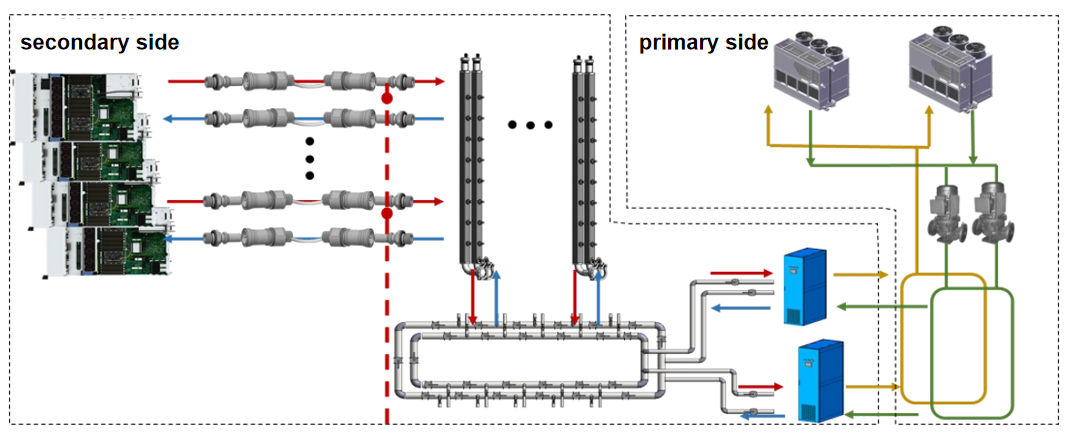
The secondary loop circulates coolant directly between the CDU and the servers.
Key components include:
Provide circulation power throughout the liquid cooling network.
Most enterprise systems utilize:
● N+1 redundancy
● Variable-speed pumps
for maximum reliability and efficiency.
The distribution piping must provide:
● High reliability
● Corrosion resistance
● Leak protection
Common options include:
● Deionized water
● Specialized dielectric fluids
High-purity coolants help prevent scaling, corrosion, and electrical conductivity risks.
The primary loop transfers heat away from the CDU.
Unlike the secondary loop, it does not directly contact IT equipment.
Heat exchange occurs through a plate heat exchanger inside the CDU.
This design ensures complete physical separation between the facility cooling system and server cooling system.
Common options include:
● Water
● Water-glycol mixtures
● Antifreeze solutions
Drive coolant circulation between the CDU and outdoor heat rejection systems.
The final stage of the cooling process removes heat from the facility.
Depending on climate conditions, several solutions may be used.
Dry coolers operate similarly to large radiators.
Advantages:
● Water-free operation
● Low maintenance
● Excellent efficiency in cooler climates
Many AI data centers utilize dry coolers to maximize free cooling opportunities.
Cooling towers reject heat through water evaporation.
Benefits:
● High thermal efficiency
● Effective in warm climates
However, they require:
● Water treatment
● Regular maintenance
In hot regions or environments requiring precise temperature control, chillers may supplement liquid cooling infrastructure.
Chillers ensure stable cooling performance even during extreme ambient conditions.
A modern liquid cooling solution would not be complete without intelligent management capabilities.
This layer acts as the "brain" of the entire cooling system.
Sensors continuously monitor:
● Temperature
● Pressure
● Flow rate
● Leak status
● Energy consumption
Real-time data enables proactive management and fault detection.
Advanced control systems dynamically adjust:
● Pump speed
● Valve positions
● Fan operation
● Coolant flow rates
based on IT load and environmental conditions.
This demand-based operation significantly reduces energy consumption.
Modern liquid cooling systems are increasingly integrated into DCIM (Data Center Infrastructure Management) platforms.
Benefits include:
✓ Centralized monitoring
✓ Alarm management
✓ Energy efficiency analytics
✓ Capacity planning
✓ Predictive maintenance
✓ Lifecycle management
This provides operators with complete visibility across both IT and facility infrastructure.
As AI workloads continue to increase, rack densities are expected to exceed 100kW and even 200kW in some deployments.
Traditional air cooling cannot efficiently support these power levels.
Cold plate liquid cooling offers:
● Superior thermal performance
● Lower energy consumption
● Greater scalability
● Improved sustainability
● AI-ready infrastructure
For operators building next-generation AI, HPC, edge, and cloud data centers, cold plate liquid cooling has become a critical technology for achieving long-term efficiency and reliability.
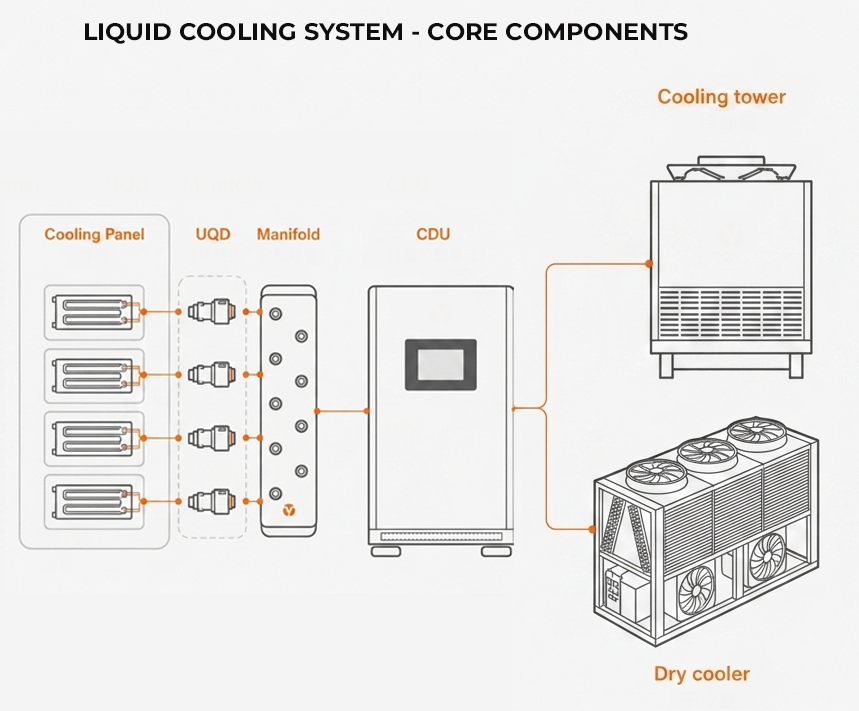
A complete cold plate liquid cooling solution consists of three integrated layers:
● Cold Plates
● Quick Disconnect Couplings
● Internal Manifolds
● Monitoring Devices
● Liquid-Cooled Servers
● CDU Systems
● Pumps
● Pipe Networks
● Primary and Secondary Loops
● Outdoor Heat Rejection Equipment
● Sensors
● Control Systems
● DCIM Platforms
Together, these technologies create a highly efficient cooling ecosystem capable of supporting the demanding workloads of modern AI and high-performance computing environments.
As data centers continue evolving toward higher rack densities and greater sustainability requirements, cold plate liquid cooling is rapidly becoming the preferred cooling solution worldwide.
Tell us your needs for data center infrastructure, and our team will provide you with customized green & energy-saving integrated solutions with global delivery and fast response.

 EN
EN