

How Heat, Humidity, Water Constraints and Outdoor Conditions Change Cooling Design
|
“Tropical cooling is not a standard design with larger equipment. It is a different operating envelope that must be engineered around the real climate, water limits and operating risks.” |
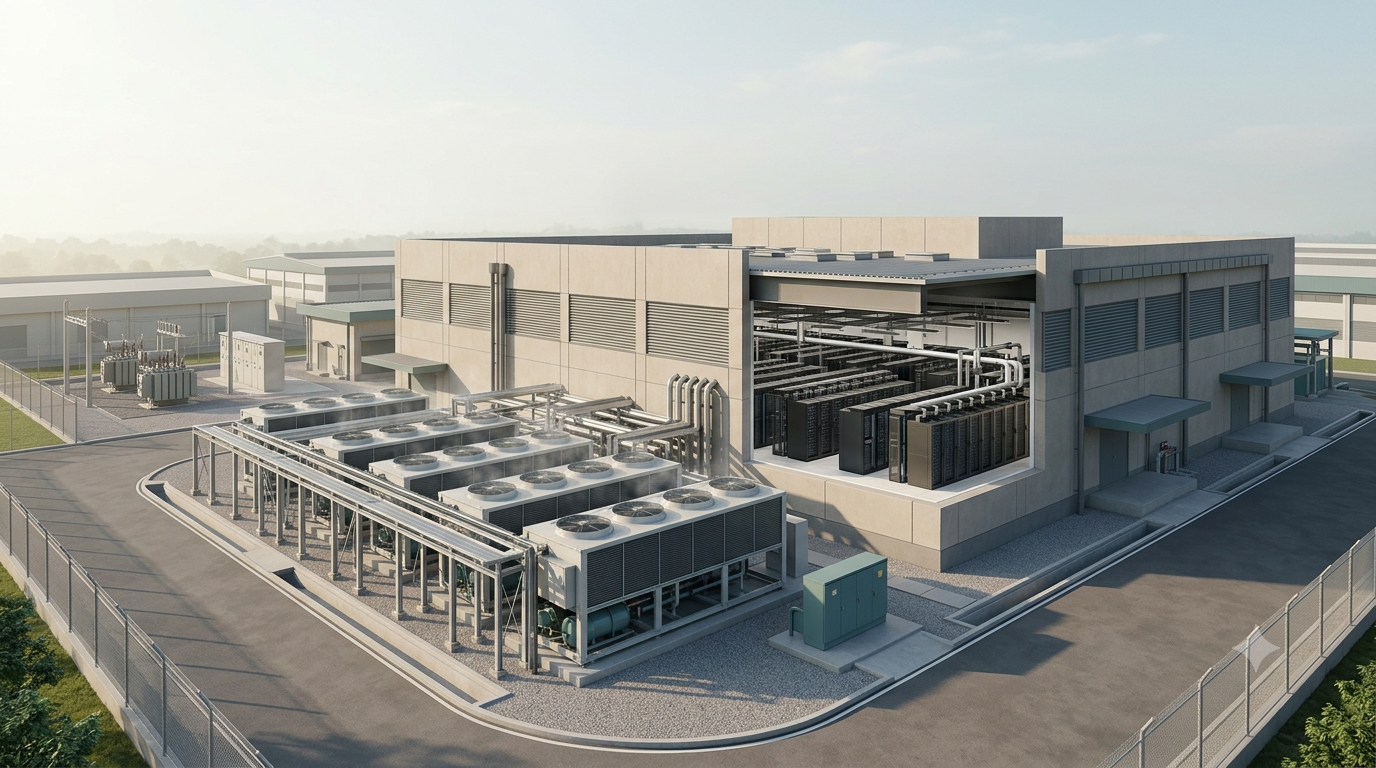
Rising rack densities are colliding with the realities of tropical deployment: high outdoor temperatures, persistent humidity, and growing pressure on both energy and water use. Under these conditions, cooling design becomes far more than an equipment-selection exercise.
A cooling system that performs well under temperate design conditions may lose capacity, consume more power or create condensation and corrosion risks when applied in Singapore, Johor, Batam or other tropical markets. The challenge is not simply to remove more heat. It is to maintain predictable thermal performance throughout the year while protecting IT equipment, controlling resource use and preserving maintainability.
Five design issues are especially important for tropical AI infrastructure.
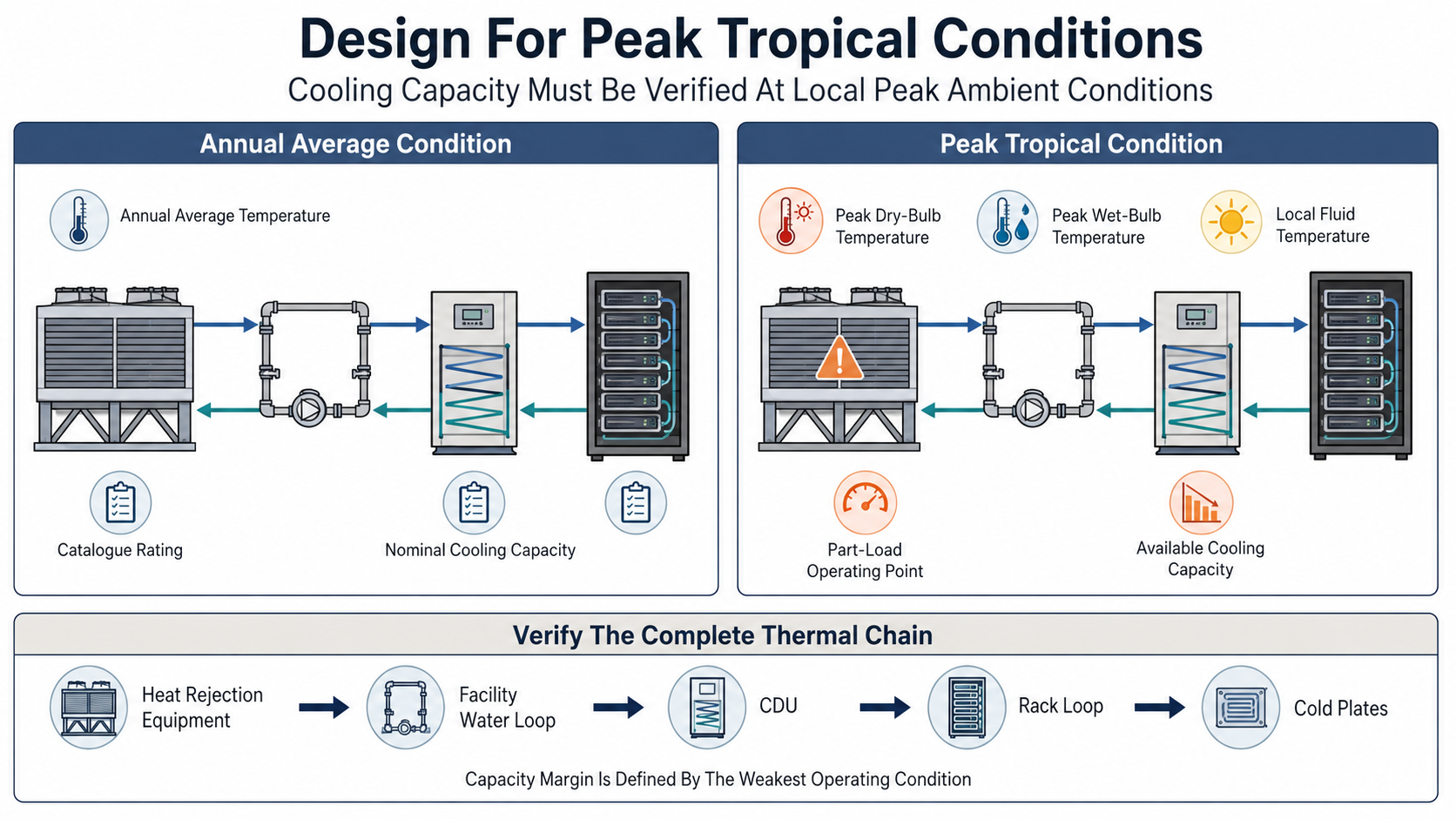
Tropical projects must be designed around the hours that place the greatest stress on the cooling system, not only around annual average temperature. Outdoor heat-rejection equipment can lose capacity as dry-bulb or wet-bulb temperature rises, while compressors, fans and pumps may operate closer to their limits.
This affects the selection and rating of air-cooled chillers, water-cooled plants, dry coolers and adiabatic systems. A unit rated at a standard catalogue condition may not deliver the same capacity during the site’s peak ambient period. Design teams should verify performance at local peak conditions, expected fluid temperatures, altitude and part-load operating points.
The thermal chain must also be checked as a complete system. Higher facility-water temperatures may improve chiller or dry-cooler efficiency, but the available approach temperature must still support the CDU, rack loop and server cold plates. Capacity margin should be based on the weakest operating condition rather than the largest nameplate rating.
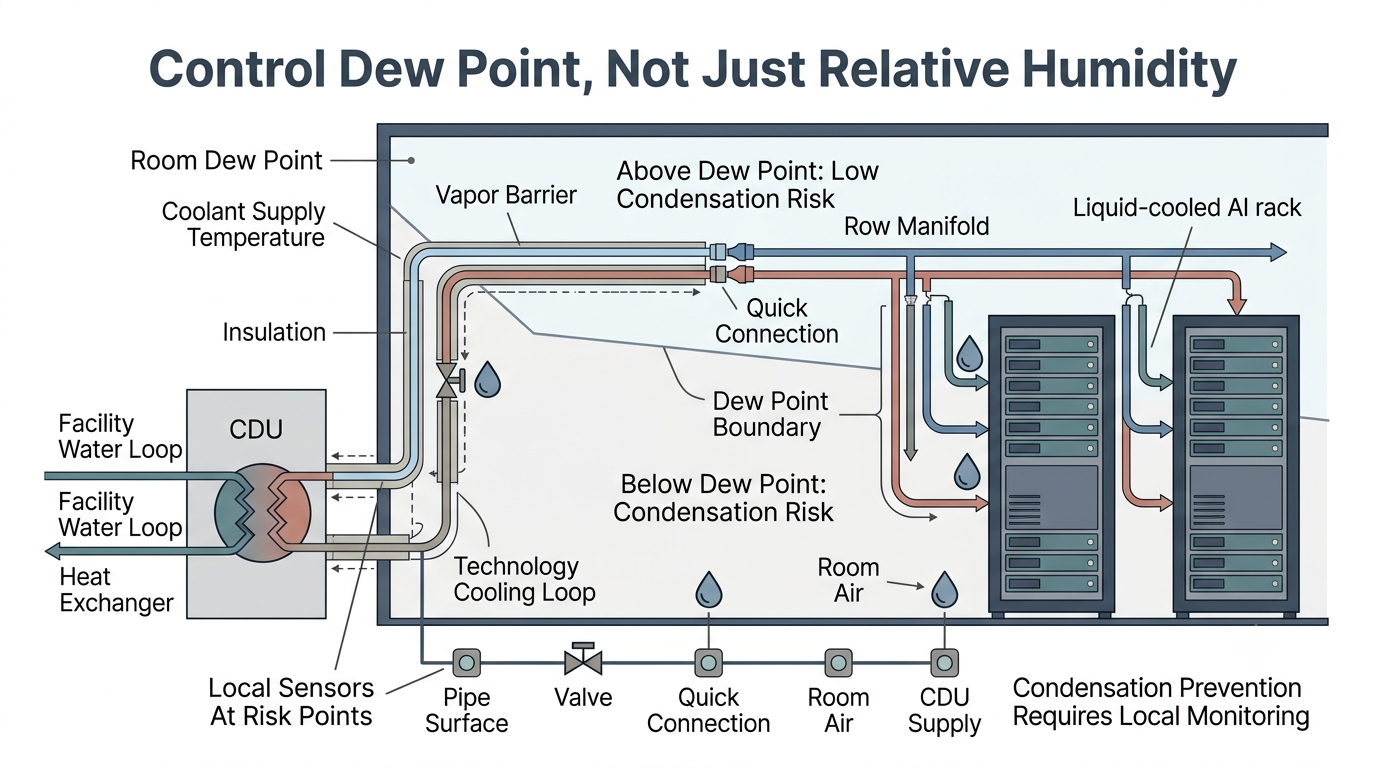
High humidity changes the condensation risk. Relative humidity alone does not show whether moisture will form on cold pipes, valves, manifolds or equipment surfaces. Dew point is the more important control parameter.
If coolant or chilled-water temperatures fall below the surrounding dew point, condensation can develop even when room temperature appears acceptable. This creates risk around pipe insulation, quick connections, service points and equipment that is opened during maintenance.
A tropical liquid-cooling design should therefore coordinate coolant supply temperature, room dew point, insulation thickness, vapor barriers and humidity-control strategy. Sensors should be located where risk actually exists, not only at a general room monitoring point. Operating sequences should also prevent the system from supplying unnecessarily cold fluid during startup, low-load operation or temporary loss of humidity control.
Singapore’s Tropical Data Centre Standard shows that higher operating temperatures can be used safely when the environmental envelope is measured and managed. The objective is controlled optimization, not simply raising setpoints.
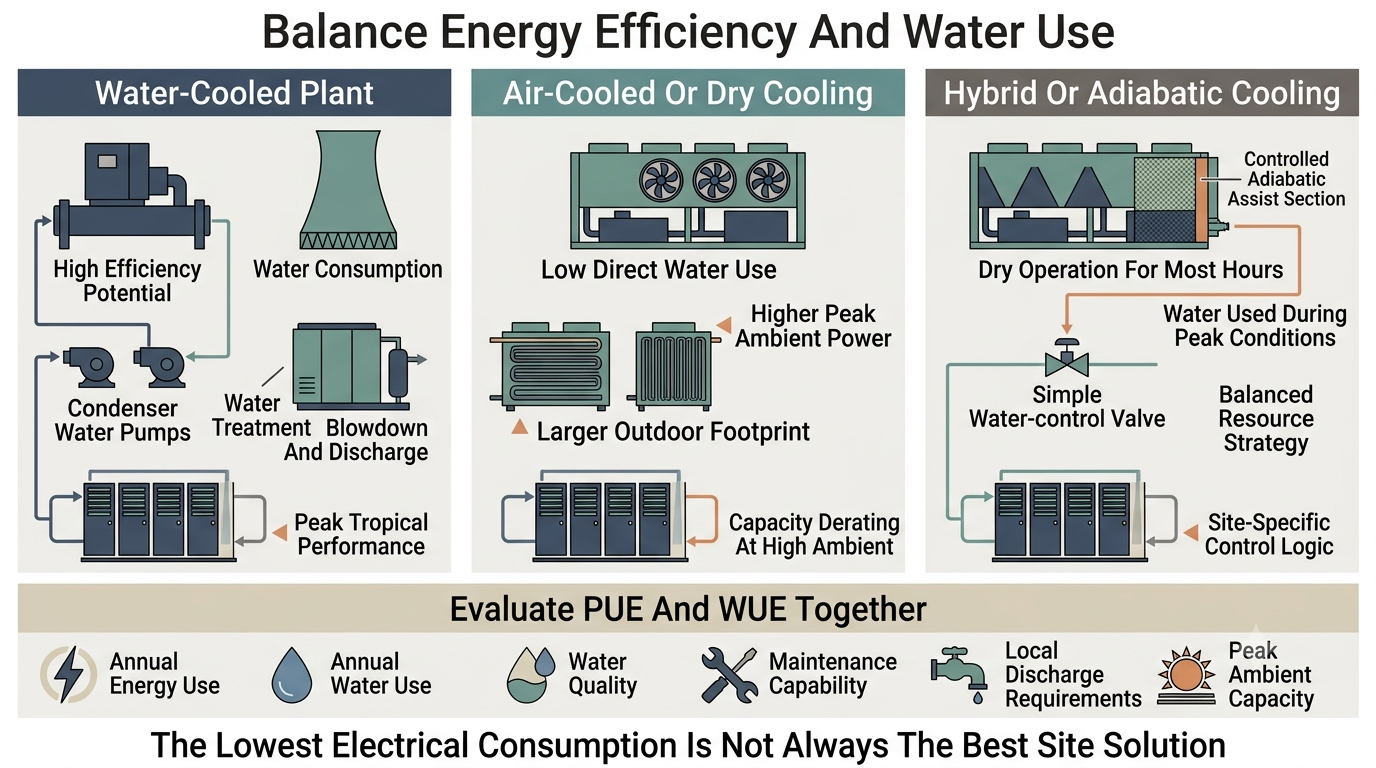
The cooling option with the lowest electrical consumption is not automatically the best solution if it depends on water that is restricted, expensive or difficult to maintain.
Water-cooled chillers and cooling towers can provide strong efficiency in hot climates, but they introduce water consumption, treatment, blowdown and plume-management requirements. Air-cooled chillers and dry coolers reduce direct water use, yet their power consumption and physical footprint may increase during peak ambient conditions. Adiabatic systems sit between these options by using water only when dry operation cannot meet the required leaving-fluid temperature.
Project teams should evaluate both Power Usage Effectiveness and Water Usage Effectiveness across realistic annual operating conditions. The decision should also include water quality, chemical treatment, maintenance skill, local discharge requirements and the commercial value of water during drought or supply restrictions.
For AI facilities, warm-water liquid cooling can widen the range of hours in which dry or hybrid heat rejection is practical. However, the achievable temperatures depend on the server technology, CDU approach temperature and residual air-cooling load.
Outdoor cooling equipment in Southeast Asia may be exposed to intense rainfall, ultraviolet radiation, salt-laden air, airborne contaminants and frequent lightning. These factors affect long-term capacity and reliability even when the initial thermal design is correct.
Coil corrosion reduces heat-transfer performance and can lead to refrigerant or fluid leakage. Electrical enclosures, fan motors, sensors and control panels require suitable protection for the installation environment. Drainage must prevent standing water around equipment, while access platforms and service clearances must remain usable during wet weather.
Coastal or industrial sites should include a corrosion assessment covering coil coatings, frame materials, fasteners, piping, electrical cabinets and maintenance intervals. Protective coatings should be selected for compatibility with heat-transfer performance and cleaning procedures rather than specified only by a generic corrosion label.
Outdoor resilience also includes lightning protection, grounding, wind loading, flood elevation and safe equipment isolation. Tropical readiness is a lifecycle design requirement, not a single IP rating.
Direct-to-chip liquid cooling can remove a large share of GPU heat, but most AI data halls still retain an air-cooling load. Memory, storage, network switches, power supplies and other components may continue to reject heat into the room.
The residual air load must be quantified rather than assumed. Row cooling, fan walls, rear-door heat exchangers or room-level systems may still be required, depending on the server architecture and liquid-cooling capture ratio. Ignoring this load can create local hotspots even when the liquid loop has sufficient capacity.
The design should also consider what happens when part of the cooling chain is unavailable. A loss of heat rejection, CDU capacity, pumping or control power can raise component temperature quickly in high-density racks. Redundancy, thermal ride-through, alarm response and controlled IT shutdown should be defined according to the business requirement.
Hybrid cooling therefore requires coordinated operation between liquid and air systems. The goal is not to maximize one technology. It is to maintain the complete IT environment safely under normal, part-load and failure conditions.
Tropical-ready cooling is not created by increasing equipment capacity or adding liquid cooling to a conventional design. It requires the site climate, IT load, water strategy, heat-rejection method and operating envelope to be evaluated together.
The strongest designs use local peak conditions, control dew point, account for both energy and water, protect outdoor equipment and preserve cooling for residual air loads and failure scenarios. These decisions should be made before rack layout, plant selection and site interfaces are fixed.
For Southeast Asian AI data centers, the most effective cooling architecture is not the one with the most impressive nameplate value. It is the one that remains efficient, maintainable and predictable through the real tropical operating year.
1. Infocomm Media Development Authority. SS 697:2023 - Deployment and Operation of Data Centre IT Equipment under Tropical Climate.
2. Infocomm Media Development Authority. Green Data Centre Roadmap. Singapore, 2024.
3. Building and Construction Authority and Infocomm Media Development Authority. BCA-IMDA Green Mark for Data Centres 2024.
4. ASHRAE Technical Committee 9.9. Thermal Guidelines for Data Processing Environments. Fifth Edition, 2021.
5. ASHRAE Technical Committee 9.9. Liquid Cooling Guidelines for Datacom Equipment Centers. Second Edition, 2014.
6. Malaysian Investment Development Authority. Guideline for Sustainable Development of Data Centre. Malaysia, 2024.
7. Telecommunications Industry Association. ANSI/TIA-942-C: Telecommunications Infrastructure Standard for Data Centers. 2024.
Tell us your needs for data center infrastructure, and our team will provide you with customized green & energy-saving integrated solutions with global delivery and fast response.

 EN
EN