How Regional Demand, Connectivity and Infrastructure Readiness Are Shaping the Next Wave of AI Capacity
|
“Southeast Asia’s advantage is not demand alone. It is the ability to match power, connectivity, climate and expansion strategy with the right market.”
|
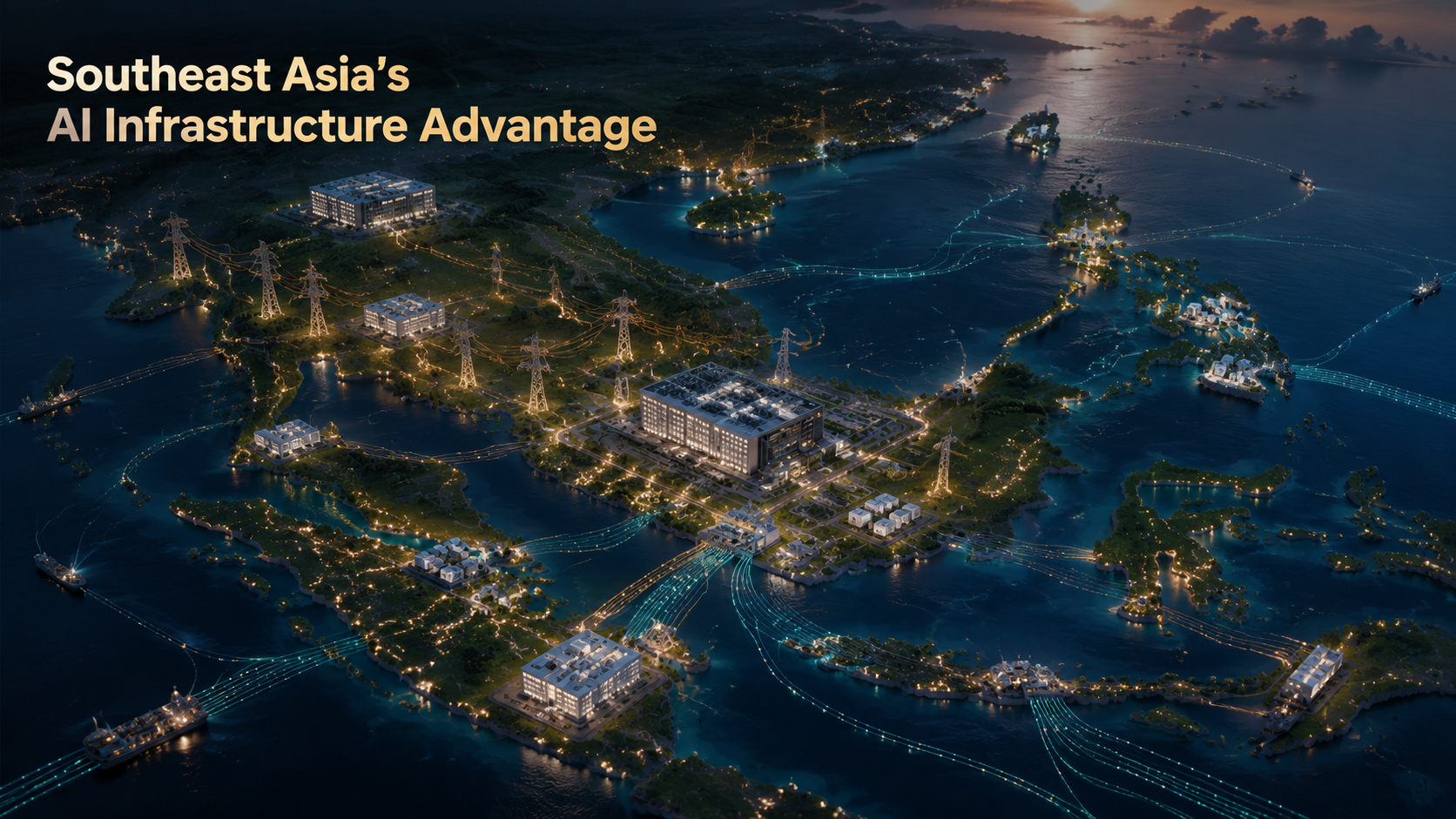
Southeast Asia is not one data center market. It is a group of AI infrastructure markets, each with different strengths in power availability, connectivity, climate conditions, regulatory requirements and expansion potential.
The region is now entering a new phase of data center development. Cloud adoption, enterprise digitalization and online services remain important, but AI is changing the scale and technical profile of demand. High-density GPU infrastructure brings greater power concentration, more demanding cooling conditions and faster changes in rack design.
The region has a strong long-term case: expanding digital demand, access to large and distributed user markets, established connectivity and several development locations with different strengths. The opportunity, however, depends on whether power, cooling, sustainability and site resilience can be aligned with the intended AI workload.
AI Is Changing What Data Center Capacity Means
AI makes capacity harder to describe through floor area or headline megawatts alone. Two facilities with the same power rating may offer very different levels of AI readiness. One may lack suitable distribution, heat-rejection capacity or room for phased expansion; another may be smaller but better prepared for high-density deployment.
The PNNL, ASHRAE and NEMA AI Data Center Energy Performance Framework notes that GPU-centric infrastructure is creating new power densities, thermal loads and interconnection requirements across the facility lifecycle. [7] The practical question is therefore no longer only how much capacity is planned, but what type of computing it can support and under which operating conditions.
A Growing and Distributed AI Market
Southeast Asia already has a broad digital demand base across cloud services, e-commerce, digital payments, online media, enterprise platforms and public-sector systems. The e-Conomy SEA report describes the region’s transition from a decade of digital expansion toward an AI-driven phase of economic development.
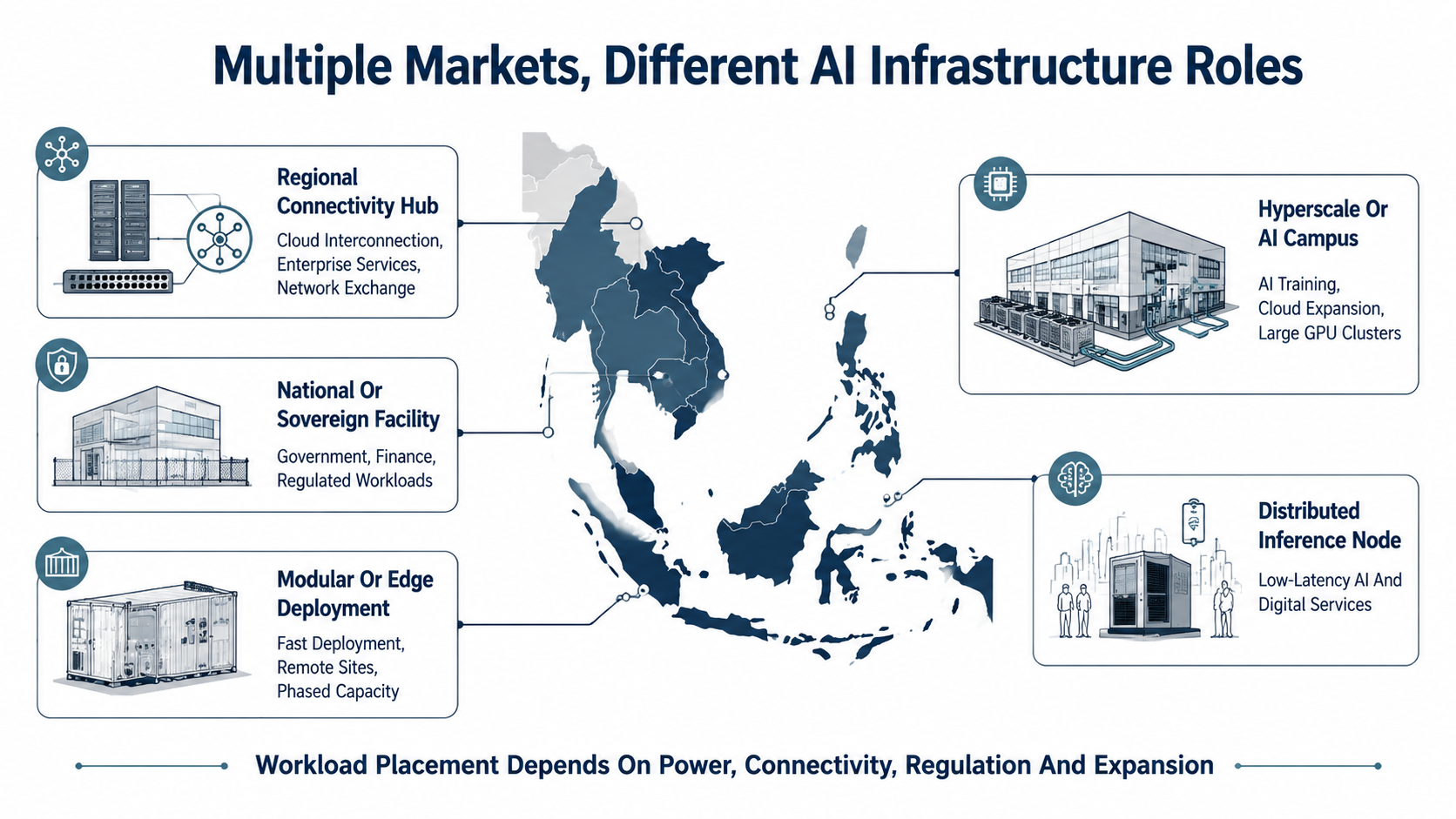
AI adds several types of infrastructure demand. Large-model training favors concentrated computing capacity; enterprise and regulated workloads increase demand for private cloud, colocation and locally controlled environments; inference places more value on proximity to users, industries and network exchange points. ASEAN’s regional digital initiatives also support longer-term integration, cross-border services and AI-driven transformation.
Because users and industries are distributed across multiple countries, Southeast Asia is unlikely to depend on one universal location strategy. Large campuses, national or sovereign facilities, colocation sites, inference nodes and modular deployments will each serve different requirements.
Multiple Development Markets Create Strategic Flexibility
The region includes mature digital hubs, large-campus markets, national cloud locations and emerging infrastructure nodes. This gives owners more flexibility to place workloads according to power availability, latency, regulation, resource conditions and future expansion.
Southeast Asia’s multi-market structure gives developers greater flexibility. Large AI training environments can be placed where power and expansion space are available, while enterprise, regulated and latency-sensitive workloads can remain closer to customers, network exchange points and national markets. This allows infrastructure to be distributed according to workload, compliance, resilience and growth requirements.
Singapore, Johor and Batam are one visible example of this multi-node pattern, but their detailed relationship should be treated separately as a site-selection and workload-placement topic. Across Southeast Asia, the broader advantage is development choice rather than dependence on a single city.
Strong Momentum, but Infrastructure Still Decides
Cushman & Wakefield reported that the Asia-Pacific data center development pipeline reached about 19.4 GW in the second half of 2025, including 3.7 GW under construction and 15.7 GW in planning. Southeast Asia represented approximately 31% of regional capacity under construction.
This confirms strong investment momentum, but planned capacity is not the same as operating capacity. Projects still depend on utility allocation, grid reinforcement, network availability, environmental approval, long-lead equipment and a cooling system suitable for the intended rack density. The strongest markets will be those that convert development pipelines into reliable infrastructure.
Power and Sustainability Are Conditions for Growth
For AI data centers, power is usually the first test of site viability. Land has limited value without confirmed utility capacity, a realistic connection date, suitable substation infrastructure, electrical redundancy and room for future phases. Transformer and switchgear lead times, grid reliability and access to lower-carbon energy can also shape the project schedule.
Efficiency is increasingly part of the power strategy. In constrained markets, reducing cooling and electrical losses allows a larger share of incoming power to support IT equipment. Singapore’s Green Data Centre Roadmap links additional capacity to higher efficiency and green-energy deployment, while the BCA-IMDA Green Mark framework evaluates energy, carbon and sustainable operation. [4][5] Malaysia’s sustainability guideline similarly addresses efficient energy and water use, cleaner energy and performance reporting. [6]
Future projects will therefore be judged not only by total megawatts, but by how much useful IT capacity they deliver with available power, water and carbon resources.
Tropical Conditions Change the Engineering Baseline
High outdoor temperatures, humidity, heavy rainfall, flooding, lightning and coastal corrosion affect site layout, equipment selection and long-term reliability. Designs developed for cooler or drier regions cannot always be transferred directly into Southeast Asia.
Cooling systems must be evaluated against actual dry-bulb and wet-bulb conditions, water availability, condensation risk, corrosion exposure and peak ambient performance. Water-cooled chillers, air-cooled chillers, dry coolers, adiabatic systems and hybrid solutions each create different trade-offs among energy use, water use, footprint, maintenance and capital cost.
Liquid cooling can remove a larger share of heat from high-density servers, but the facility-side heat-rejection system must still match local climate, operating temperatures and redundancy requirements. There is no universal best solution; the correct architecture is the one that remains reliable and efficient under the site’s real conditions throughout the year.
What Will Define Southeast Asia’s Next Phase of Growth
Southeast Asia’s strength does not come from one country, one cost advantage or one technology. It comes from the combination of growing digital demand, access to large user markets, regional connectivity and multiple locations capable of supporting different infrastructure roles.
The strongest projects will make early decisions about power, connectivity, cooling, water, resilience and future expansion. They will evaluate capacity not only by announced megawatts, but by the type of computing that can be supported efficiently and sustainably.
Southeast Asia is emerging as an AI data center hub because it offers both demand and development choice. Its long-term success will depend on how effectively each market converts those advantages into reliable, resource-conscious and scalable digital infrastructure.
References
1. Google, Temasek and Bain & Company. e-Conomy SEA 2025: From Digital Decade to AI Reality. 2025.
2. ASEAN Secretariat. ASEAN Digital Master Plan 2030. 2026.
3. Cushman & Wakefield. APAC Data Centre Update: H2 2025. 2026.
4. Infocomm Media Development Authority. Green Data Centre Roadmap. Singapore, 2024.
5. Building and Construction Authority and Infocomm Media Development Authority. BCA-IMDA Green Mark for Data Centres. Singapore.
6. Malaysian Investment Development Authority. Guideline for Sustainable Development of Data Centre. Malaysia, 2024.
7. PNNL, ASHRAE and NEMA. AI Data Center Energy Performance Framework. 2026.




 EN
EN