


How Connectivity, Large-Scale Capacity and Regional Diversification Are Reshaping AI Infrastructure Deployment
|
“Singapore = Connectivity And Control Johor = Scale And AI Campuses Batam = Diversification And Indonesia Access” |
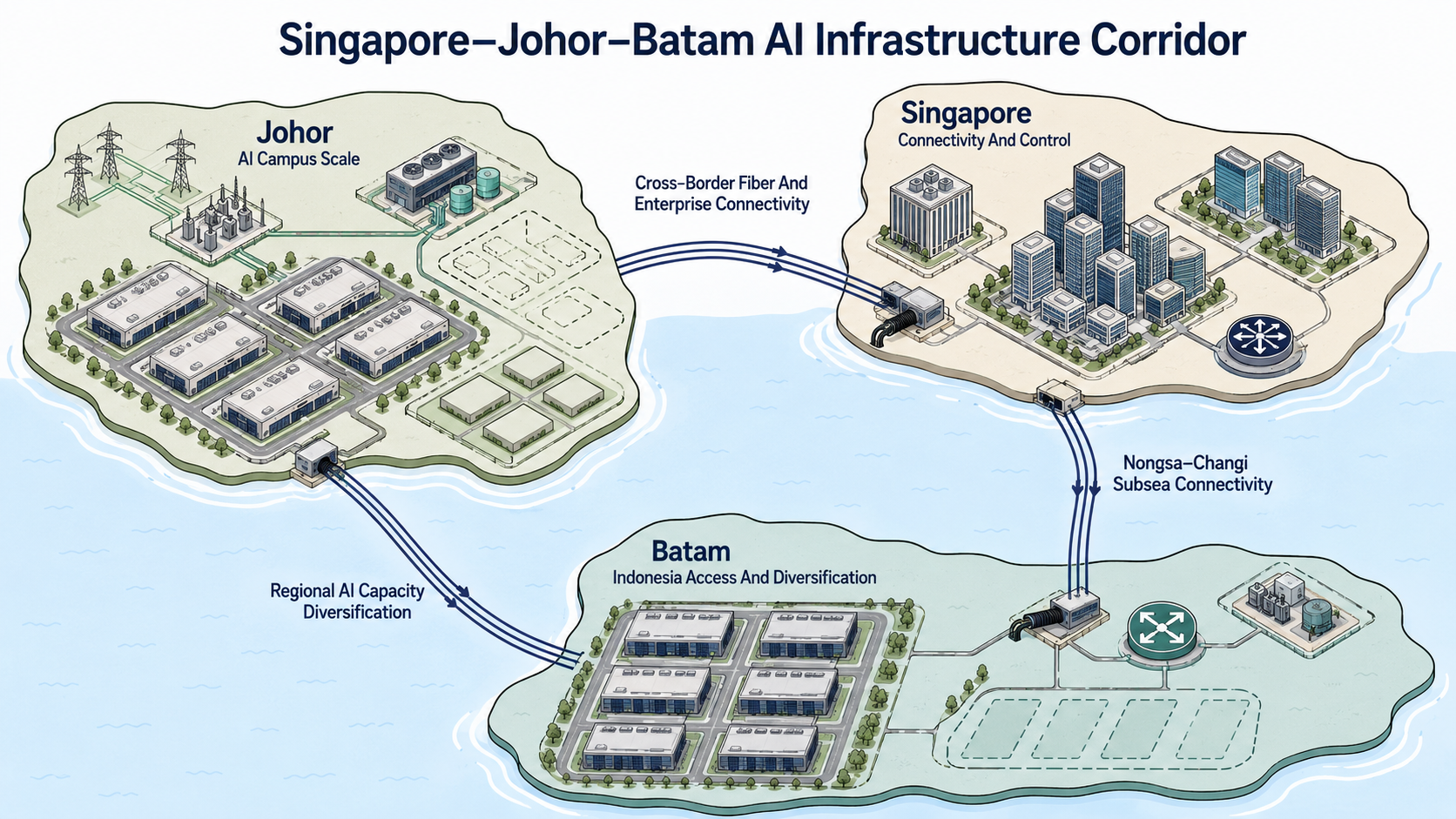
Singapore has long served as the strategic anchor of Southeast Asia’s data center ecosystem. Its strength in connectivity, enterprise demand and cloud infrastructure remains unmatched in the region, but the rise of AI is beginning to reshape where new capacity can be developed at scale.
High-density campuses require far more than additional white space. They depend on large and expandable power allocations, sufficient land, advanced cooling readiness and room for phased growth. These requirements are pushing operators beyond a single-market strategy and toward a connected Singapore–Johor–Batam capacity corridor.
The three locations are not substitutes for one another. Each offers a different combination of customer access, network density, development scale, regulatory conditions and geographic reach. The more relevant question is therefore not which market is best, but which workloads and infrastructure functions are best placed in each location.
Singapore: Connectivity and Control
Singapore’s value is not defined only by the number of megawatts it can host. Its strategic advantage lies in international connectivity, customer proximity, operational maturity and the concentration of cloud, carrier, financial and enterprise ecosystems.
The country remains particularly relevant for cloud and carrier interconnection, financial and regulated workloads, regional enterprise platforms, latency-sensitive services and cross-market operational control. Its Digital Connectivity Blueprint aims to support a doubling of submarine-cable landings over ten years, reinforcing Singapore’s role as an international network exchange point.
Singapore is also adopting a more selective, resource-conscious approach to data center growth. This does not make it less important. It makes its role more specialized: high-value capacity, customer access, interconnection and regional coordination, while some large-scale AI build-outs are developed in nearby markets.
Johor: Scale and AI Campuses
Johor is developing into a primary build-out market rather than a lower-cost overflow location. Its proximity to Singapore supports business and network coordination, while larger sites allow operators to plan multi-phase hyperscale and AI campuses.
Structure Research estimates that Johor’s contracted data center capacity increased from just under 400 MW at the end of 2023 to more than 2.3 GW by the end of 2025. Project activity also shows a shift from land announcements to secured infrastructure. Racks Central signed an electricity supply agreement for the first 100 MW phase of its Johor AI campus, designed for high-density workloads and advanced liquid-cooling infrastructure.
TM and Singtel’s Nxera are developing an AI-ready campus in Iskandar Puteri. The initial phase is planned at 64 MW, while the wider development has secured 280 MW of electricity supply. Together with the Johor-Singapore Special Economic Zone, these projects support Johor’s role in AI training, GPU clusters, cloud expansion and phased campus development.
Scale does not remove execution risk. Utility delivery dates, water strategy, long-lead electrical equipment, construction capability and operational resources still determine whether planned capacity can become reliable AI infrastructure.
Batam: Diversification and Indonesia Access
Batam offers a different proposition. Its value lies in Indonesia-facing capacity, regional diversification and improving cross-border connectivity with Singapore.
The Nongsa-Changi Cable is designed to provide more than 1.6 petabits per second of new capacity between Batam and Singapore with latency below two milliseconds. This strengthens direct data center-to-data center connectivity and supports cloud, AI and resilience requirements across the Singapore Strait.
Batam is also beginning to host larger AI-ready facilities. NeutraDC Nxera Batam’s first building has an initial 18 MW IT load, scalable to 54 MW in later phases. These developments create opportunities for Indonesian workloads, disaster recovery, phased expansion and geographically distributed capacity.
Batam should not be treated simply as a low-cost substitute. Power availability, network routes, local operations, supply-chain maturity, regulation and future expansion must still be assessed at project level.
One Corridor, Three Roles
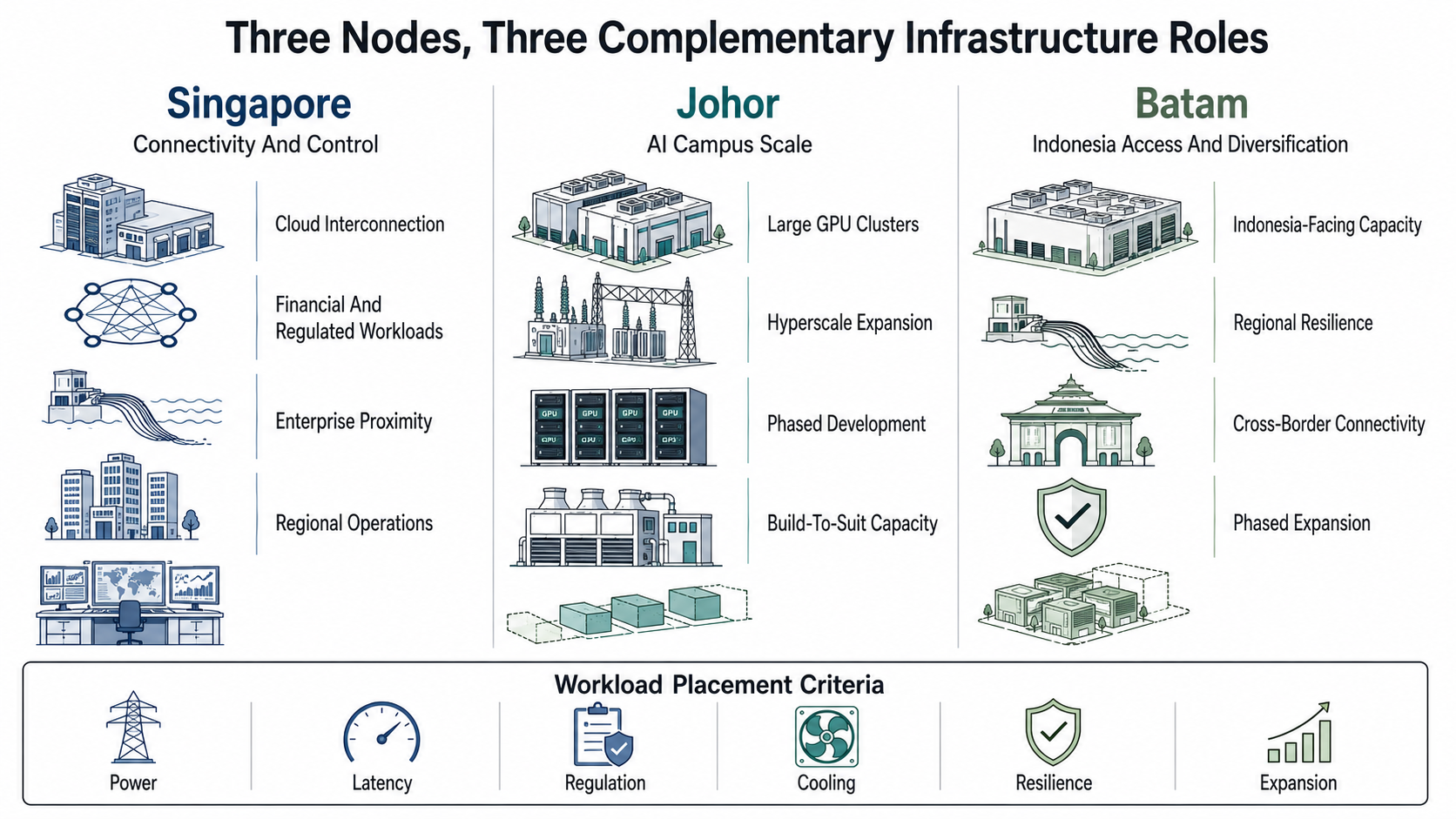
The three markets are best understood as complementary nodes rather than substitutes. Their roles reflect differences in connectivity, site scale, customer access and development readiness.
These roles are directional rather than fixed. Final placement still depends on the operator’s business model, compliance obligations, power strategy and resilience objectives.
Workload Placement Comes First
A simple country ranking provides limited value. The most connected market may not have enough power for a large AI campus, while a site with available land may not provide the regulatory or operational fit required by a specific workload.
Large AI training clusters may favor Johor’s scale and expansion potential. Financial, regulated and latency-sensitive services may remain closer to Singapore’s customers and interconnection ecosystem. Indonesia-facing applications and regional resilience strategies may benefit from Batam. Multi-site business continuity can use all three nodes, provided network, regulatory and operational dependencies are properly designed.
What Makes the Corridor Work
Geographic proximity alone does not create an integrated infrastructure corridor. Cross-border bandwidth, route diversity and latency must be matched with credible power delivery, data-residency requirements and clear operating responsibilities.
Multi-location projects also require coordinated supply chains, spare-parts strategies, emergency procedures and common operating standards. Business continuity must confirm that network, power and operational risks are sufficiently independent rather than merely distributed across nearby sites.
The corridor becomes valuable when these elements are planned as one portfolio. Without that coordination, Singapore, Johor and Batam remain three separate markets located close to one another.
A Multi-Market Infrastructure Strategy
A regional AI strategy cannot use one fixed design for every site. Utility voltage, ambient conditions, water availability, cooling method, protection requirements, construction capability and expansion schedules can differ significantly across the corridor.
At the same time, designing every facility entirely from the beginning creates unnecessary cost and variation. A more practical model standardizes the core architecture for power, cooling, monitoring and modular deployment, while adapting capacities, heat-rejection systems and site interfaces to local conditions.
For prefabricated or containerized infrastructure, this means using an adaptable platform rather than a fixed product. The same engineering principles can support different markets, but equipment ratings, environmental protection and deployment phases must remain project-specific.
A Corridor, Not a Ranking
Singapore, Johor and Batam should not be evaluated as three versions of the same market. Singapore provides connectivity, customers and regional control. Johor provides the scale required for large AI campuses. Batam adds Indonesia access and geographic diversification.
The strongest deployments will place each workload according to its actual requirements for power, latency, regulation, resilience and future growth. In the AI era, the competitive unit may no longer be a single facility or country. It can be a connected portfolio of sites, each performing a different infrastructure role.
References
1. Infocomm Media Development Authority. Singapore’s Digital Connectivity Blueprint. 2023.
2. Structure Research. Johor & Batam DCAI Report 2026: Data Centre Colocation, Hyperscale Cloud, AI & Interconnection. 2026.
3. Racks Central. TNB and Racks Central Sign Electricity Supply Agreement for Johor AI Data Center Campus. 2026.
4. Telekom Malaysia. TM and Singtel’s Nxera Form Joint Venture to Develop Next-Generation Data Centres. 2024.
5. TM Nxera. TM Nxera Secures 280MW to Power AI-Ready, Green Data Centre Campus in Johor. 2026.
6. Telin and BW Digital. TelkomGroup, Nongsa Digital Park, and BW Digital Strengthen Indonesia’s Digital Gateway through the NCC Submarine Cable System. 2026.
7. NeutraDC. TelkomGroup Tops Off NeutraDC Nxera Batam Hyperscale Data Center to Power the AI Ecosystem. 2025.
Tell us your needs for data center infrastructure, and our team will provide you with customized green & energy-saving integrated solutions with global delivery and fast response.

 EN
EN