


The UPS panel board is the piece of switchgear that splits your UPS output into protected branch circuits - and in most projects it is specified last and blamed first. Size it against the wrong numbers and the breakers trip every time the UPS rides through an overload, or worse, they never trip when they should. This guide covers what the panel actually does, how to match it to your UPS, and when factory-integrated beats field-assembled.
Walk the power path of any data center and the sequence is fixed: utility intake, generator, UPS, panel board, rack PDU, server. The UPS conditions power and bridges outages. The panel board takes that conditioned output - typically 380/400/415 V three-phase in our markets - and divides it into branch circuits, each protected by its own breaker, each feeding one rack PDU or one piece of equipment.
Three jobs, in order of how often they cause trouble:
In our own product line this sits under power distribution systems: the integrated UPS power distribution panel, standard power distribution panels, electrical pods and control panels, rated for low-voltage distribution up to 1,000 V.
This is the part most guides skip, and it is where factory integration earns its keep. A double-conversion UPS does not hold full output forever under overload - it transfers load to bypass after a defined time. You have to know that curve before you set branch breaker ratings, because during every transfer the panel sees raw mains-side conditions, not conditioned UPS output.
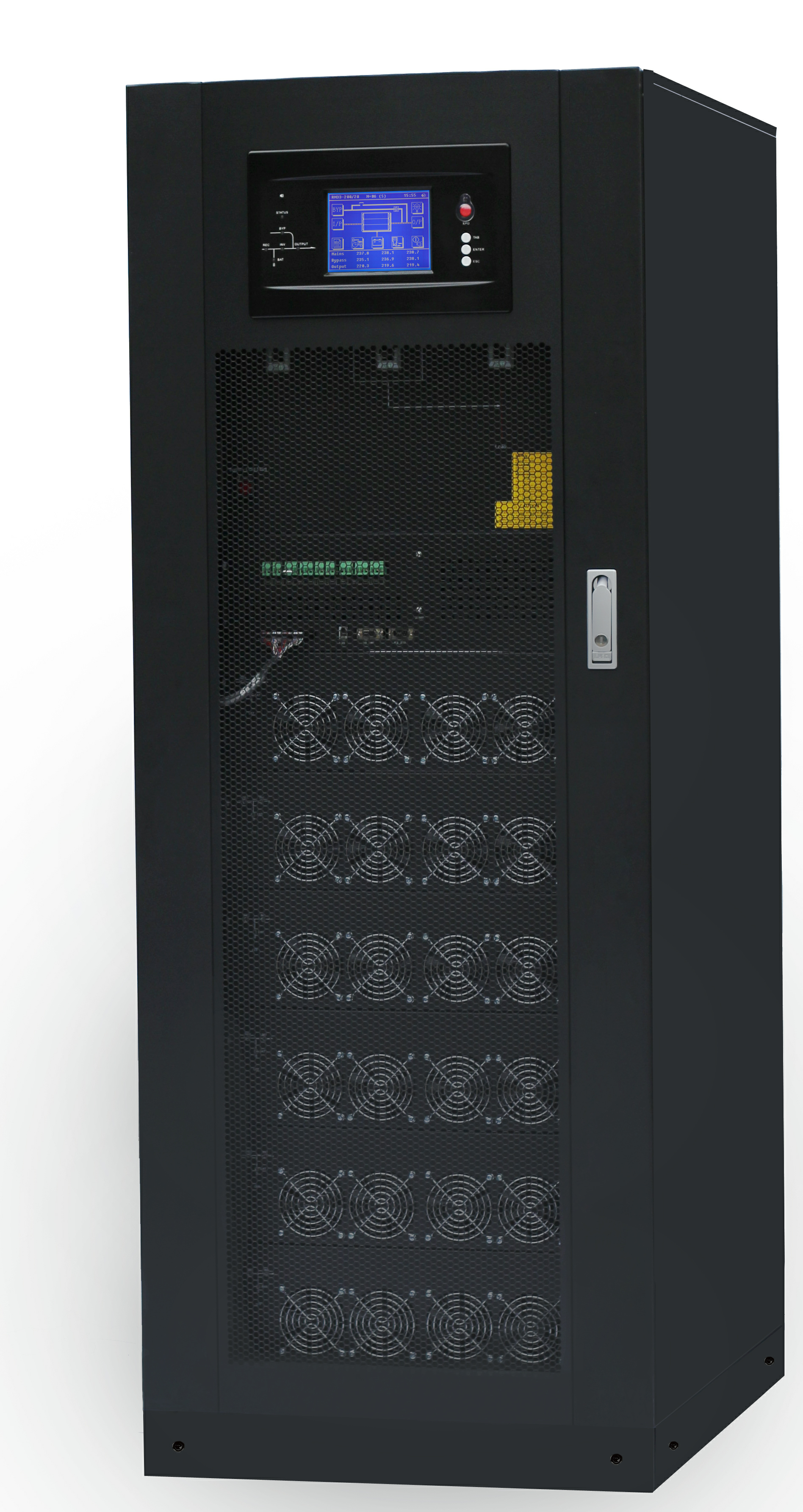
Our tower UPS line (ZT-TH33, 10 to 180 kVA) publishes exactly these numbers: 110% overload holds for 60 minutes before transferring to bypass, 125% holds 10 minutes, 150% holds 1 minute. What that means for the panel: branch breakers must tolerate these short excursions without cascading trips, and the panel incomer must be rated for the bypass path, not just the inverter.
Three more upstream numbers that flow straight into panel specification:
A field-assembled panel is bought from a switchgear vendor, shipped to site, and wired to the UPS by the electrical contractor. It works - on paper. In practice, three things go wrong before energization:
The factory-integrated route folds the panel into the UPS delivery: one manufacturer wires UPS, distribution panel and batteries into one train, runs the combined test at the works, and ships it as a documented system. In our containerized and micro-module projects this is the default - the integrated UPS power distribution panel arrives with the UPS already coordinated against it, test reports included. For a standalone UPS room the same logic applies at smaller scale; the premium over field assembly is usually a rounding error next to one week of commissioning delay.
| Cost driver | Impact | How to control it |
| Branch metering scope | High | Meter critical circuits only; static loads get basic ways |
| Selectivity engineering | Medium | Demand the study in writing - retrofit coordination costs far more |
| Factory integration | Low-medium | Cheapest when ordered with the UPS, not retrofitted |
| Spare ways | Low | 20% spare costs little on day one; a second panel later costs a shutdown |
| Enclosure rating and form factor | Medium | IP20 indoor as standard; harsher environments drive the price |
One honest warning: the panel is rarely the line item that busts the budget, but it is the most common cause of delayed energization. Buy it with the UPS, from the same works, with a combined test report.
What is the difference between a UPS panel board and a PDU?
The panel board is the first distribution stage on the UPS output - it divides the output into branch circuits at 380/400/415 V. The rack PDU is the last stage inside the server cabinet, taking one branch circuit and splitting it into C13/C19 outlets. Branch panel, then rack PDU, in that order.
Can the panel board be factory-integrated with the UPS?
Yes, and for data center work we recommend it. The integrated UPS power distribution panel ships wired, labeled and tested with the UPS as one system - including overload-curve coordination - which removes the interface risks of field assembly.
How do I size branch breakers for a three-phase UPS output?
Start from the UPS output ratings, not the panel's nameplate: for a ZT-TH33 at 0.9 output power factor, branch current follows the real per-circuit load at 380/400/415 V, then apply the selectivity study so branch breakers ride through the UPS's documented overload transfers - 110% for 60 minutes on that series - without nuisance tripping.
Author: [Yvonne Sun], Overseas Marketing, Zhejiang Zhiting Information Technology Co., Ltd. - manufacturing data center power infrastructure since 2009: UPS from 1 to 600 kVA, distribution panels to 1,000 V LV, CE / ISO certified, OEM/ODM supported.
Tell us your needs for data center infrastructure, and our team will provide you with customized green & energy-saving integrated solutions with global delivery and fast response.

 EN