

From Factory Frame to Site Installation: How a Prefabricated AI Data Center Is Actually Integrated
The Container Is Visible. The Interfaces Are Where the Engineering Happens.
|
A prefabricated AI data center is not “a container with equipment inside.” Its real value lies in how power, cooling, structure, controls and site interfaces are engineered as one system before delivery. |
Prefabricated data centers are often described by their most visible feature: the module.
That can be a container, a steel-framed POD, a power module or a hydraulic module.
But the enclosure is not what makes the system modular.
The real engineering value comes from moving a large portion of the integration work from the construction site into a controlled manufacturing environment.
Power, cooling, racks, busbars, piping, controls and supporting structures can be assembled and tested before shipment.
That changes not only where construction happens. It changes how the project should be designed.
The first stage is not fabrication. It is defining interfaces.
Before production begins, the project team should establish IT load, rack configuration, electrical architecture, cooling architecture, redundancy strategy, site utility conditions, module boundaries, shipping limits, installation method and future expansion plan.
A module cannot be designed correctly without knowing what connects to it.
For example, a hydraulic module may need defined interfaces for facility-water supply and return, technology cooling-system supply and return, drains, power, control signals, and BMS or DCIM communication.
The same is true for an electrical module. The internal system can be factory-tested, but the external utility interface still has to match the actual site.
The earlier those boundaries are fixed, the less rework appears during manufacturing.
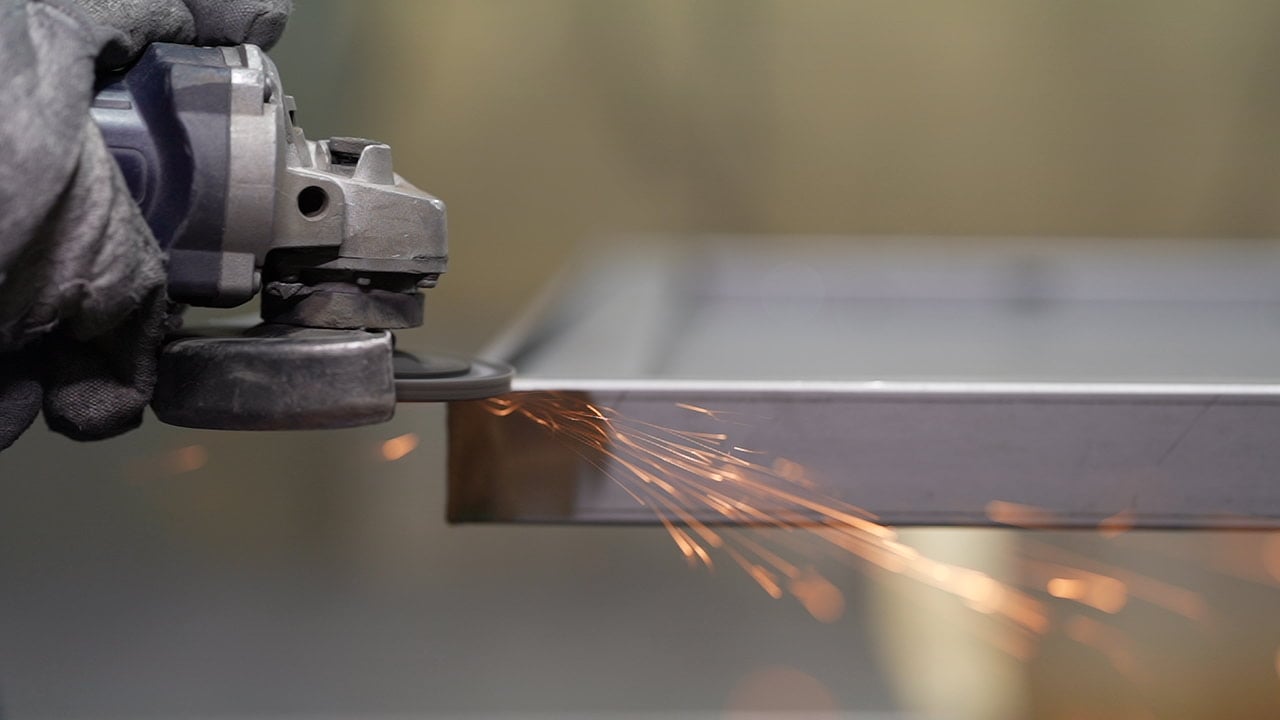
Once the design is released, structural fabrication begins.
For a steel-framed AI POD, this may include main columns, horizontal beams, diagonal bracing, equipment bases, door frames, overhead support structure, lifting and transportation features.
Welding quality and dimensional tolerances are critical because every downstream system depends on the geometry of this frame.
A small structural deviation can later create problems with busbar alignment, pipe routing, cabinet installation, door fit, containment and inter-module connection.
The frame also needs to support more than its own weight. Depending on the design, it may carry power distribution, cooling pipes, fiber trays, containment and maintenance loads.
Therefore the structural calculation should reflect the finished system, not only the bare steel.
After fabrication stages, the steel structure requires an appropriate surface-preparation and coating process.
This is often misunderstood as an aesthetic step. It is not.
The expected environment — indoor, industrial, humid, coastal or highly corrosive — influences surface preparation, primer, intermediate layers, topcoat, total dry film thickness and inspection requirements.
For outdoor modular systems, corrosion protection should be defined at the design stage rather than decided after the frame has been manufactured.
The coating system must also account for welds, edges, fasteners, cut surfaces and field repair areas.
A beautifully painted frame can still have poor corrosion protection if the substrate preparation is inadequate.
Once the structural platform is ready, the module starts becoming infrastructure.
Depending on its function, factory integration can include electrical systems such as switchboards, UPS, busbar, PDU, rack power distribution, control panels, grounding and cable tray; cooling systems such as CDU, pumps, heat exchangers, supply and return headers, manifolds, valves, strainers, sensors and leak detection; ICT infrastructure such as fiber tray, network pathways, management cabling and monitoring interfaces; and supporting systems such as doors, containment, lighting, fire-system interfaces, DCIM/BMS sensors and access control.
The key word is interface.
A high-quality module is not a collection of individually good products. It is a system in which the products have already been engineered to work together.
In conventional construction, equipment from multiple suppliers may meet for the first time on site.
That means clashes, wiring errors, control conflicts and physical-fit problems are often discovered late.
Prefabrication moves more of those discoveries upstream.
Current industry guidance increasingly describes modular construction as a factory-first model in which equipment is assembled, integrated and tested while site civil works proceed in parallel.
That parallelism is one reason modular approaches can reduce deployment schedules.
But speed is the consequence. The more fundamental advantage is predictability.
A problem discovered in the factory is usually easier to solve than the same problem discovered after a crane has already placed the module on site.
Factory Acceptance Testing should not be limited to checking whether individual devices power on.
For an integrated module, the test plan should verify system-level behaviour.
Depending on scope, FAT may include mechanical inspection, electrical continuity and insulation, switchgear operation, UPS modes, control logic, pump operation, pressure and leak testing, sensor verification, alarm simulation, communication, redundancy switching and emergency sequences.
The module should leave the factory with a defined configuration baseline.
That includes approved drawings, software versions, alarm settings and test records.
Otherwise, the site team receives a physical object without a reliable engineering history.
The project is not finished when FAT is complete. It now has to move.
Transport introduces another engineering condition that may be very different from normal operation.
The team needs to confirm total transport dimensions, weight, centre of gravity, lifting points, crane capacity, road restrictions, shipping restraints, weather protection and vibration-sensitive equipment.
Some systems can remain fully installed during transport. Others may require sensitive or heavy components to be shipped separately.
These decisions should be made during design, not the week before dispatch.
When the module reaches site, the visible installation may look simple: lift it, position it, connect it.
In reality, successful installation depends on work completed months earlier.
The site needs completed foundations, verified anchor positions, finished drainage, utility power interfaces, cooling connections, network entry points, grounding, safe crane access and approved installation drawings.
For multi-module projects, positional tolerance becomes especially important.
Two factory-built modules may each be manufactured correctly but still fail to connect efficiently if the site interface between them is inaccurate.
Factory testing cannot prove every site condition.
After installation, Site Acceptance Testing should verify the parts of the system affected by transport, field joints, site power, external cooling, controls integration and final network connections.
Integrated Systems Testing may then verify normal and failure behaviour across the completed facility.
The full acceptance chain therefore looks more like: Design → Manufacturing → Factory Integration → FAT → Transport → Installation → SAT → Integrated Testing → Operation. Not simply: Factory → Delivery.
The strongest reason to modularize AI infrastructure is not to put everything inside a container.
It is to create repeatable engineering.
When a module has defined interfaces, controlled manufacturing, repeatable testing, documented installation and standard connection points, the next phase does not need to start from zero.
That is where modular construction becomes strategically valuable.
The first unit is a project. The second, third and tenth units can become a platform.
And in an AI market where infrastructure needs to scale faster than traditional construction cycles, repeatability may be more valuable than the enclosure itself.
1. Vertiv, What Is a Modular Data Center?, updated September 2026. https://www.vertiv.com/en-us/insights/articles/educational-articles/what-is-a-modular-data-center/
2. ASHRAE / PNNL / NEMA, AI Data Center Energy Performance Framework – Integrated Design Principles, 2026. https://www.ashrae.org/technical-resources/topics-and-initiatives/ai-data-center/integrated-design-principles
3. NVIDIA Technical Blog, Achieve Productive AI Capacity Faster and More Predictably with NVIDIA DSX POD, October 21, 2026. https://developer.nvidia.com/blog/achieve-productive-ai-capacity-faster-and-more-predictably-with-nvidia-dsx-pod/
4. ABB, Modular Data Center Offering – Deployment and Commissioning Process. https://library.e.abb.com/
Tell us your needs for data center infrastructure, and our team will provide you with customized green & energy-saving integrated solutions with global delivery and fast response.
 EN