 EN
Common operational risks arising from inadequate data center asset management
From my hands-on experience supporting colocation and hosted infrastructure customers in multiple regions, I’ve seen a lot of incidental issues caused by deficiencies in data center asset management. Many facility teams still utilize manual methods to track data center assets (such as spreadsheets or paper records). The lack of an automated method to track data center assets can lead to data drift. As assets are moved, swapped or retired, the records can gradually lose alignment with the actual state of the data center.
An example of this was a colocation customer who was expanding their tenant racks. The customer utilized manual logging methods for data center asset management. As new tenant hardware was shipped to the customer, field technicians were sent to perform move add change tasks on the tenant rack. However, the centralized inventory management system was often not updated in a timely manner, leading to a loss of alignment between the actual state of the data center and management system.
Operators couldn't verify exact locations of a large group of tenant assets after a few quarters. Capacity planning became difficult, and response time to handle hardware faults became longer. They later adopted our DCIM solution to rebuild their unified asset inventory to include physical rack placement, power dependencies and records of preventive maintenance, all within the same system. This gradually resolved confusion during turnover of tenant hardware and improved service quality to their customers.
This experience is comparable to what is described in Advancing DCIM with IT Equipment Integration, in the ASHRAE Datacom SeriesASHRAE. This resource aligns with the challenges we noted regarding the inability to access consistent views of all assets in a data center and the risks this creates for both colocation and enterprise data centers. Effective asset management for data centers gives capacity planners and change control managers tools to ensure sufficient resources are available for service requests and avoid unscheduled outages, particularly in multi-tenant data centers.
Core functional foundations of structured data center asset management
Working hands-on with Colocation and Hosted Infrastructure customers across multiple regions, I have witnessed many incidents related to poor asset management within Data Center Facilities. I have encountered facilities teams that still use spreadsheets or local paper records to track IT hardware, power components and cooling components. Frequently, these records don’t reflect the current configurations of the Data Center.
An example of this was a colocation project in which a regional hosting provider expanded tenant racks within their facility and relied on manual logs to manage asset records. As new tenant hardware was shipped, field technicians would perform a variety of tasks to provision the hardware without updating the centralized inventory to reflect the true configuration of the Data Center.
After a few quarters, operators could not confirm exact device locations, power draws, and warranty status for a large portion of tenant assets. Capacity planning became difficult, and troubleshooting slowed when unexpected hardware faults occurred. The operator eventually implemented our DCIM solution to create a unified asset inventory, physical rack placement, and power and dependence relationships and maintenance records, to name a few. With this, they began to systematize and simplify tenant hardware turnover and improve the quality of service they provided to their colocation clients.
This example follows the examples described in Advancing DCIM with IT Equipment Integration by ASHRAE and the challenges experienced by both enterprise and colocation data centers due to an inability to manage data center assets reliably. It emphasizes that data center asset management helps facilities effectively plan and respond to changes in infrastructure to support capacity and change management requirements in a multi-tenant environment where equipment ownership is crossed among multiple clients.
Workflow and process improvements to strengthen data center asset management
Even capable tooling cannot deliver full value without standardized supporting workflows for data center asset management. Many facilities invest in management software yet keep loose informal field procedures. Manual onsite adjustments happen without formal ticket logging, new hardware gets deployed before asset entries are created, and retired devices remain inside inventory long after physical removal. Those habits gradually degrade data quality no matter how feature rich the supporting platform may be.
Working with multiple colocation customers, our engineering team typically suggests three practical process adjustments. First, enforce ticket driven move add change workflows. Any hardware installation, relocation or decommission triggers corresponding asset record updates inside DCIM before and after onsite work completes. Second, schedule periodic physical asset reconciliation cycles. Technicians perform spot cross-check between actual rack hardware and digital asset records, correcting mismatches before they accumulate. Third, define clear role based permission sets inside the management platform. Different staff groups including field technicians, tenant support representatives and planning analysts get appropriate access scopes, preventing unapproved modification to critical asset datasets.
Our DCIM system supports these process requirements through built-in permission controls, audit logging and reconciliation assisting functions. For colocation scenarios, tenant related asset information can be logically separated, so each hosted customer can view their own assigned asset set without accessing other tenant records. This separation helps hosting providers satisfy data isolation expectations common among enterprise colocation clients. All platform functions go through full feature verification during factory testing phases. When delivered to customers, the system comes with configuration documentation and workflow guidance to accelerate onsite adoption of robust data center asset management routines.
Capacity planning and tenant service quality driven by data center asset management
Well managed data center asset information provides multiple benefits for data center service providers, beyond merely risk management. Accurate asset information allows data center operators to predict space, power and cooling capacity, and helps manage consumed versus available resources. Knowledge of available resources enables data center managers to make smart decisions on new client engagements, and reduces the possibility of resource overcommitment. Absence of reliable asset information may cause data center managers to unknowingly overcommit available resources and potentially put tenant infrastructure at risk.
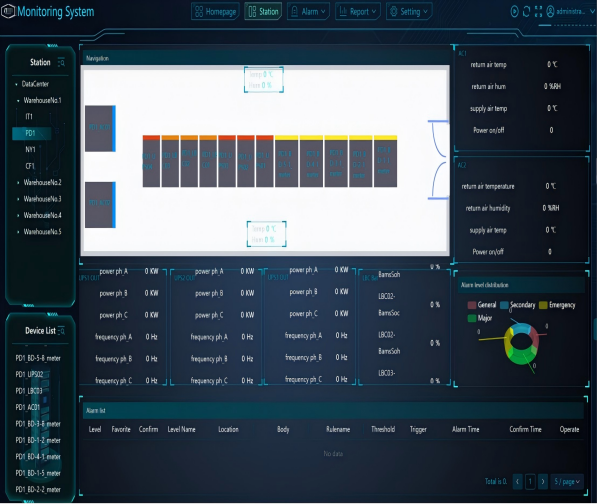
Our DCIM uses asset information to provide visibility of capacity at the rack, power and cooling zones. Facility managers can visualize how deployed tenant equipment occupies resource headroom and plan where new tenant equipment can be installed. When incoming colocation customer orders rack space, planning and facility managers use our DCIM to understand whether the existing facility can support the new order or if an expansion of the facility is needed.
Correct management of data center assets helps manage tenant support requests. When a tenant support request is raised for equipment that is behaving anomalously, the support staff can pull the asset information, including the equipment power feed, maintenance history, and installation history, in our DCIM. Reduction in mean time to repair is significant for colocation businesses, as it enables them to respond quickly to the needs of competitive market tenants.
Long term lifecycle governance and continuous optimization for data center asset management
Data center asset management involves tracking equipment from the time it's procured, through deployment and removal. Full lifecycle management is important because various equipment go through changes during their lifecycle and neglecting to manage equipment during these stages can cause problems. The terms ghost assets and zombie assets refer to equipment that have been deployed and removed but still exist in an inventory system. Ghost assets can cause problems with spare part stock and compliance reporting.
The DCIM we provide has the capability to track assets from procurement to end-of-life. Users can track warranties, preventive maintenance schedules and retirement status of assets. The system has an audit trail for records after a asset has been removed from a data center. The system also enables colocation tenants to manage different client assets in their data center.
When a DCIM is implemented in a data center, our team provides training and instructions for best practices to ensure the system functions as expected. Our team also provides remote support to improve data center asset management processes. Healthy asset data practices allow hosting operators to continue serving their clients and gather useful information to assist them make informed decisions on where to allocate their capital for the future.
Frequently Asked Questions
Q1: What main risks come with poor data center asset management for colocation operators?
A: Outdated inventory creates capacity miscalculation, slower incident response and mixed-up tenant hardware records. These issues hurt service reliability and customer satisfaction for hosting facilities.
Q2: What key capabilities should reliable DCIM bring for data center asset management?
A: Core capabilities include unified asset inventory, rack position mapping, move add change audit trail, power dependency mapping and role-based access separation for multi-tenant colocation environments.
Q3: Can DCIM import existing asset records from spreadsheets during initial deployment?
A: Yes. Our DCIM supports bulk asset import to accelerate initial setup. Manual physical reconciliation after import remains necessary to align digital records with real onsite hardware conditions.
Q4: How does good data center asset management improve colocation tenant experience?
A: Accurate asset data speeds up troubleshooting, clarifies resource allocation and supports transparent capacity reporting. Tenants receive clearer visibility for their own deployed hardware inside shared facility space.
Q5: Does data center asset management work only for large scale data center sites?
A: No. Both smaller colocation sites and enterprise computer rooms benefit from structured asset tracking. DCIM functions can scale according to actual asset quantity without mandatory large-scale hardware upgrade.
Table of Contents
- Core functional foundations of structured data center asset management
- Workflow and process improvements to strengthen data center asset management
- Capacity planning and tenant service quality driven by data center asset management
- Long term lifecycle governance and continuous optimization for data center asset management