

Updated November 25, 2026 | Industry Insights
Rising AI infrastructure power density is prompting data-center teams to reconsider how electricity moves from the grid to computing equipment. Solid-state transformers (SSTs) are attracting attention because they combine power electronics with high-frequency isolation, supporting more integrated conversion between medium-voltage AC and downstream power distribution.
Public announcements in 2026 show progress across several areas: safety certification, customer applications, semiconductor collaboration and platform development. These developments are encouraging, but they represent different types of evidence. A customer installation, a component certificate and a development partnership should not be treated as equivalent milestones.
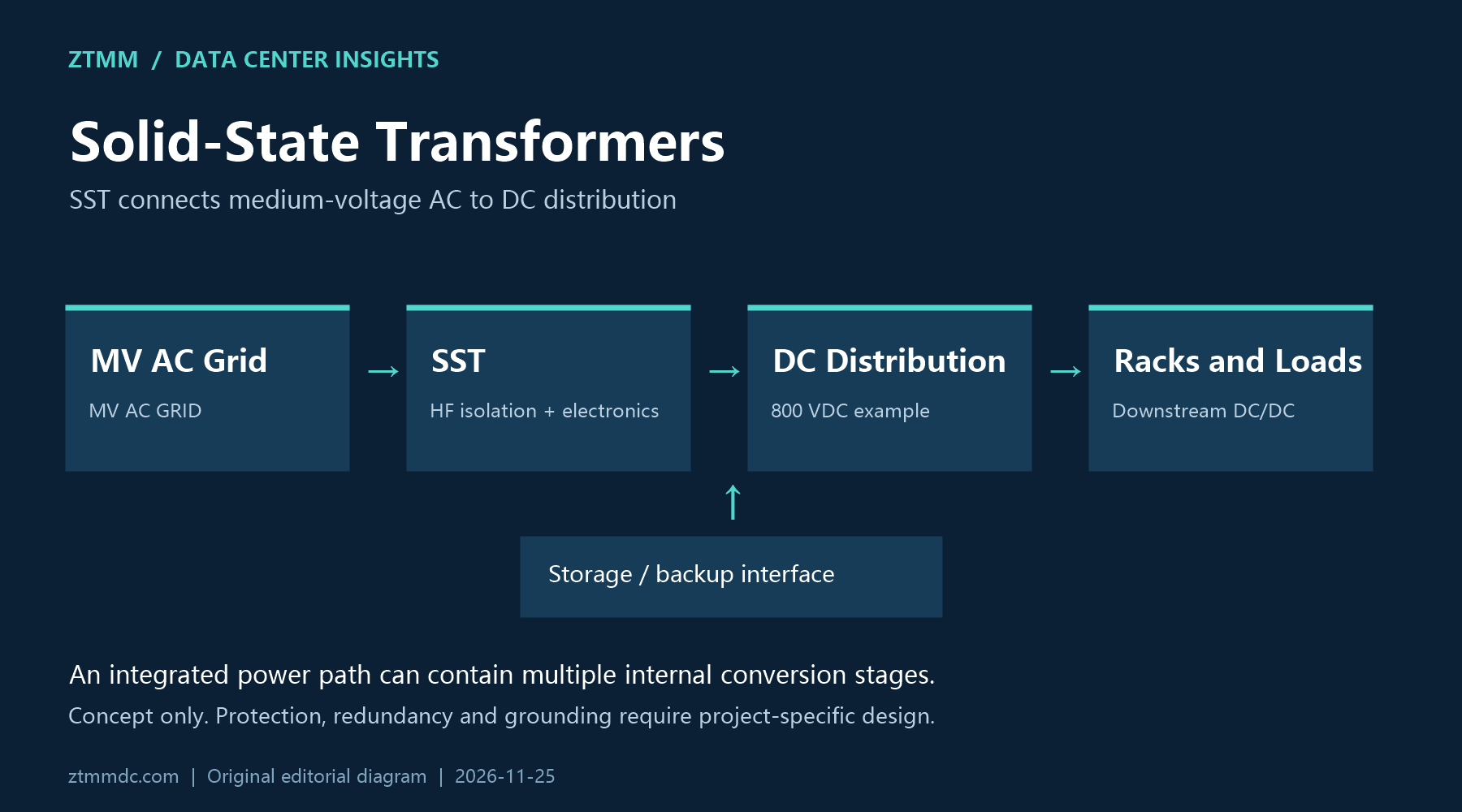
Figure 1. Conceptual relationships between the medium-voltage grid, an SST, DC distribution and downstream loads. Protection, redundancy and energy-storage interfaces require project-specific engineering.
An SST combines semiconductor switching, high-frequency magnetic isolation and control. Some data-center platforms convert medium-voltage AC into 800 VDC, providing an alternative interface for DC distribution and subsequent rack-level conversion.[1][2]
“Direct conversion” describes the integrated system and its input/output interfaces. It does not mean that the equipment contains only one internal conversion stage. SSTs also retain high-frequency magnetic components; they do not automatically eliminate backup power, energy storage or protection equipment.
The opportunity is to reduce selected standalone equipment and interfaces while supporting more controllable power delivery. Actual benefits depend on operating load, redundancy, cooling demand, protection and maintenance—not simply a headline efficiency figure.
Eaton disclosed TÜV SÜD certification for its MV SST in 2026, referencing IEC 62477-2 and safety evaluations including insulation, partial discharge and environmental performance. On September 29, Infineon announced that it would supply silicon carbide power devices for Eaton’s APAC MVSST 2.0 platform.[3][4]
Eaton also publishes a US-market 15 kV-class, 2 MW outdoor liquid-cooled MVSST. Regional platforms must be evaluated separately: specifications and certificates should not be combined into an assumed universal product configuration.[1]
A third-party transcript of Eaton’s November 3 earnings call records management reporting that the US 15 kV, 2 MW unit passed all UL tests in October. The corresponding certificate number and certification scope were not independently verified for this article, so this is presented as a management-reported testing milestone rather than confirmation of a particular UL listing.[5]
Delta’s February 2026 official brand report describes an SST installation at Chindata’s North China campus. The report discusses multiple DC output voltages and a distributed SST-plus-DC-bus architecture.[6]
The relevance is practical integration: power conversion, controls, loads and potential energy-storage interfaces must work together at a customer site. A published installation is useful evidence, while vendor-reported results remain specific to the stated project and operating conditions.
On August 14, 2026, Siemens and Reinhausen announced cooperation to develop and industrialize an SST for AI data centers, targeting grid connections up to 36 kV and an 800 VDC output.[7]
The announcement brings together grid equipment and power-electronics expertise. Its stated stage is development and industrialization; it does not establish completed certification or volume delivery.
On October 15, Sungrow announced TÜV Rheinland system-level and key-component certification for the EnerNeo SST. Its release identifies UL 2877, IEC/EN 62477-series and other evaluation standards, alongside cTUVus and EMC certification and high-frequency isolation-transformer assessment.[8]
Evaluation against a UL standard should be distinguished from certification issued by UL Solutions. Buyers need to identify the certifying body, applicable mark, model coverage and installation conditions. Certification supports market access but does not replace delivery records or operating history.
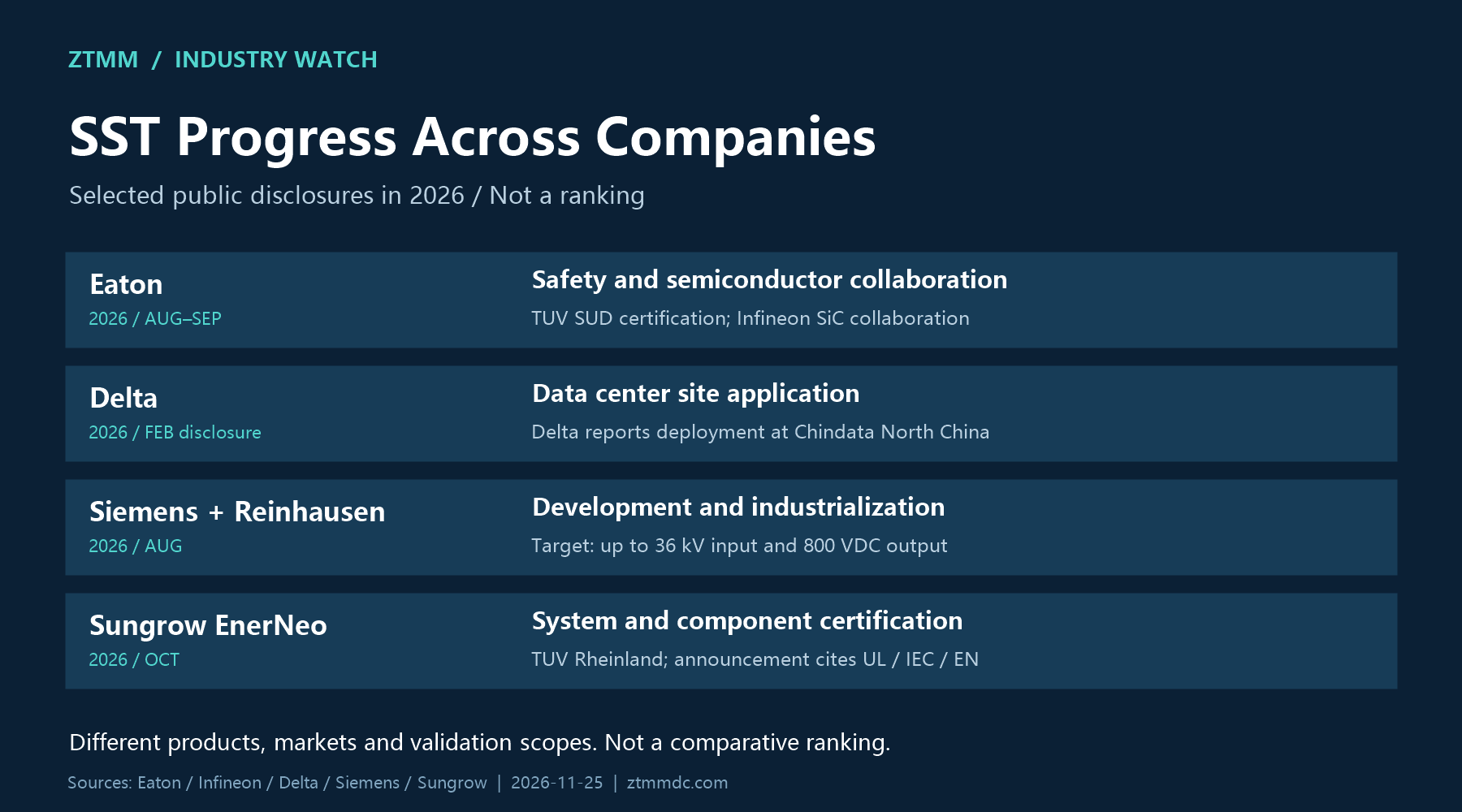
Figure 2. Selected company disclosures, organized by evidence type. Different products, markets and evaluation scopes prevent a direct maturity or performance ranking.
Availability and serviceability. Define fault isolation, module redundancy, bypass and maintenance procedures. Review behavior during module loss, cooling faults and communication failures against the project’s required availability.
Consistent efficiency boundaries. Compare complete architectures under representative load profiles. Include auxiliary power, cooling, storage interfaces and downstream conversion. An SST’s peak efficiency alone cannot establish annual energy savings or a facility’s PUE improvement.
DC protection and integration. Fault interruption, grounding, insulation monitoring, battery fault contribution, busways and connectors need coordinated design. SST adoption does not remove these requirements.
Compatibility and lifecycle cost. New construction and retrofits have different constraints. Rack input requirements, backup duration, future expansion, spare parts and maintenance capability should be assessed alongside installation and commissioning costs.
The 2026 disclosures indicate a broadening SST ecosystem, with progress in customer applications, certification and next-generation development. For data-center owners, the practical question is whether a particular platform can support a maintainable, expandable power architecture with the required availability.
Project decisions should therefore draw on verified certification documents, operating evidence and system testing, while considering the interaction between power distribution, storage, cooling and monitoring.
Planning a high-density data center or evaluating an 800 VDC architecture? Contact the ZTMM team through ztmmdc.com to discuss your project’s power, space and expansion requirements.
1. Eaton MVSST product information
2. Delta COMPUTEX 2026 technology overview
3. Eaton TÜV SÜD certification announcement
4. Infineon–Eaton announcement, September 29
5. Eaton earnings-call transcript, November 3; third-party transcription
6. Delta customer application report, February 2026
Tell us your needs for data center infrastructure, and our team will provide you with customized green & energy-saving integrated solutions with global delivery and fast response.
 EN