

How to Design a Modular AI Data Center for 5MW-to-50MW Phased Expansion
The Difference Between a 5MW Project and a 50MW Campus Is Not Ten Copies of the Same Design
|
Building 5MW is an engineering project. Building the first 5MW of a future 50MW campus is a master-planning decision. |
A customer planning the first 5MW of AI capacity may ask a simple question: ‘Can this expand to 50MW later?’
The easy answer is yes. The engineering answer is much longer.
A facility that can technically add another module is not necessarily a facility that can scale economically, operationally or reliably to ten times its initial capacity.
The first 5MW should therefore be designed in two dimensions: What does Phase 1 require today? And what decisions must be made today so that Phase 10 is still possible tomorrow?
That is the difference between modular equipment and modular infrastructure strategy.
A phased project should not design Phase 1 in isolation.
The project team should first establish an approximate ultimate masterplan covering total IT capacity, land requirement, utility capacity, substation strategy, generator or alternative backup strategy, cooling plant, water, fiber, roads, module locations and maintenance access.
That does not mean every future phase needs detailed engineering on day one.
It means Phase 1 must avoid blocking the physical or electrical path required by later phases.
A cheap Phase 1 decision can become an expensive Phase 4 demolition.
One of the most important decisions is the size of the repeatable infrastructure block.
Depending on the project, that might be 1MW, 2.5MW, 5MW or another project-specific capacity.
There is no universally correct number.
The block size should align with utility architecture, transformer size, UPS topology, cooling topology, generator strategy, rack population, network architecture and construction sequence.
A smaller block gives finer expansion increments. A larger block may simplify equipment count and reduce repeated infrastructure.
The goal is to find a unit that can be manufactured, tested, installed and commissioned repeatedly without forcing the entire campus to be redesigned at each phase.
A useful way to think about a large modular campus is: backbone infrastructure + repeatable capacity blocks.
The backbone may include utility interconnection, medium-voltage distribution, main substation, campus fiber, central roads, drainage, security and selected cooling infrastructure.
The repeatable blocks may include IT PODs, power modules, UPS modules, hydraulic modules and cooling modules.
The challenge is deciding which systems should be central and which should scale with each block.
Too much centralization creates a large initial CapEx commitment. Too much decentralization creates unnecessary equipment duplication.
The correct answer depends on reliability, scale, land and commercial strategy.
Power architecture is usually the hardest part to change later.
Future expansion should therefore be considered in the medium-voltage switchgear lineup, transformer bays, protection zones, bus rating, cable routes, generator space, battery systems and utility interconnection.
For example, Phase 1 may only install part of the final equipment. But the masterplan should know where future equipment connects.
Space without an electrical interface is not true expansion capacity.
The same applies to fault current and protection coordination. As the campus grows, the electrical system changes.
Future phases should not accidentally push the original system outside its intended operating envelope.
If IT capacity grows from 5MW to 50MW, cooling is not only a question of adding ten times the nominal cooling capacity.
The hydraulic system must also scale.
Future planning needs to consider main pipe sizing, pump architecture, zoning, CDU arrangement, isolation valves, water treatment, heat-rejection capacity and redundancy.
Large liquid-cooled sites should avoid creating one uncontrolled hydraulic network.
Zoning allows maintenance, leak isolation, phased commissioning and operational separation between capacity blocks.
ASHRAE's 2026 AI Data Center Energy Performance Framework specifically highlights modular design, phased expansion and zoned liquid systems as AI facilities increase in scale.
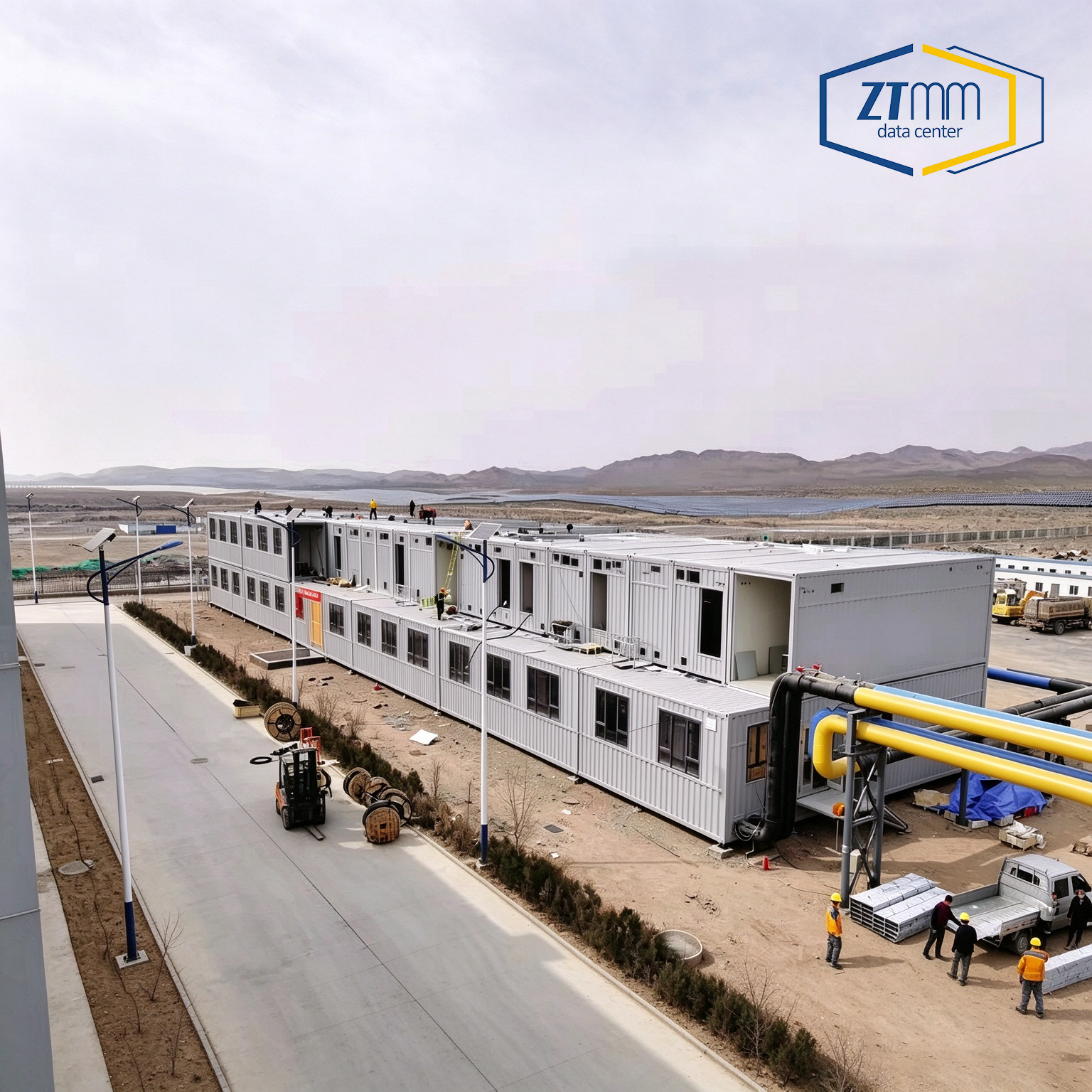
Land reserved for expansion has value only if future construction can reach it.
The masterplan should preserve crane access, module delivery routes, transformer replacement routes, cooling equipment access, fire lanes, maintenance corridors, pipe corridors and cable corridors.
A frequent expansion problem is not lack of land. It is that Phase 1 occupied the easiest access route.
The future construction sequence should therefore be considered before permanent equipment is placed.
A 50MW campus may take years to complete.
During that time, GPU generations, rack densities and cooling requirements can change substantially.
Trying to freeze every component at Phase 1 can create obsolescence.
Instead, standardize the interfaces.
Electrical interfaces may include module voltage, protection philosophy, connection point and monitoring protocol. Cooling interfaces may include facility-water temperature range, pressure range, flange or connection standard and control signals. Network interfaces may include fiber entry, pathways, network zones and management interfaces. Structural interfaces may include module grid, anchoring, service clearances and transport envelope.
This allows future modules to evolve internally while still connecting to a common campus architecture.
That is much more resilient than forcing a 2030 module to look exactly like a 2026 module.
N+1 and 2N sound straightforward at 5MW. At 50MW, the architecture becomes more nuanced.
The project needs to decide whether redundancy exists at equipment level, module level, power-train level or campus level.
A 5MW block may be able to isolate a failure locally. A highly centralized system may expose several blocks to the same upstream failure.
Therefore expansion planning should identify failure domains.
Ask: If this transformer fails, how many MW are affected? If this hydraulic header is isolated, how many racks lose cooling? If this controller fails, how many modules depend on it?
The objective is not necessarily to duplicate every component. It is to understand the consequences of each failure.
Modular construction creates an important advantage: the project can learn while it expands.
The first capacity block generates real information about installation duration, commissioning, thermal performance, power quality, alarm logic, maintenance access and operator workflow.
That information should feed directly into the next phase.
ASHRAE's current commissioning guidance notes that AI data center phases may follow each other only months apart, making rapid feedback from commissioning and operations increasingly important.
A repeatable design should not mean repeating known mistakes. Standardization should include controlled improvement.
One reason modular expansion is attractive is financial.
Instead of installing the complete 50MW facility before customer demand exists, infrastructure can be deployed in increments.
That may reduce stranded capacity and align capital investment more closely with contracted demand, GPU availability, utility capacity and customer revenue.
The industry increasingly describes this as a pay-as-you-grow approach.
But the economics only work if future phases do not repeatedly require redesigning or replacing earlier infrastructure.
The engineering strategy makes the financial strategy possible.
Phase 0 — Masterplan: Define the ultimate site, grid, cooling, network and logistics strategy.
Phase 1 — Prove the Block: Deploy the first repeatable power, cooling and IT architecture.
Phase 2 — Standardize: Use FAT, SAT and operating feedback to correct interfaces and installation procedures.
Phase 3 — Replicate: Add capacity using controlled, repeatable modules.
Phase 4 — Upgrade: Allow future modules to support new GPU densities without breaking the original campus architecture.
Phase 5 — Campus Optimization: At larger scale, optimize shared infrastructure, energy systems and operating strategy across all blocks.
A scalable data center is not one with empty land beside it.
It is one in which the next MW has already been considered in the electrical topology, cooling network, structural grid, network backbone, logistics plan and control architecture.
That is why the first 5MW of a 50MW AI campus is often the most important phase.
Not because it is the largest. Because it establishes the rules every future phase will inherit.
1. ASHRAE / PNNL / NEMA, AI Data Center Energy Performance Framework – Integrated Design Principles, 2026. https://www.ashrae.org/technical-resources/topics-and-initiatives/ai-data-center/integrated-design-principles
2. ASHRAE / PNNL / NEMA, Site Planning – Scalability and Future Expansion, 2026. https://www.ashrae.org/technical-resources/topics-and-initiatives/ai-data-center/site-planning
3. ASHRAE, Commissioning & Performance Validation – AI Data Center Energy Performance Framework, 2026. https://www.ashrae.org/technical-resources/topics-and-initiatives/ai-data-center/commissioning-performance-validation
4. Vertiv, What Is a Modular Data Center?, 2026. https://www.vertiv.com/en-us/insights/articles/educational-articles/what-is-a-modular-data-center/
5. Eaton, The Future of White Space and Data Hall Design: From Megawatts to Gigawatts, 2025. https://www.eaton.com/us/en-us/markets/data-centers/knowledge-center/the-future-of-white-space-and-data-hall-design.html
Tell us your needs for data center infrastructure, and our team will provide you with customized green & energy-saving integrated solutions with global delivery and fast response.
 EN