

Source: https://dcbuildx.com/blogs/insights/schneider-rapidscale-ai-pod
Two announcements landed within 48 hours of each other this October, and together they describe the same product from opposite ends. On October 21 at GTC Berlin, NVIDIA unveiled DSX POD — a Vera Rubin AI factory built inside shipping-container-sized modules, validated in a factory before it ever touches a truck. The same day, at booth 3041, Schneider Electric introduced the piece of the puzzle that makes such a product buildable at scale: RapidScale Modular Data Center Reference Design 115, a pre-engineered, validated blueprint for high-density AI infrastructure that Schneider explicitly calls the "foundational first step toward supporting the NVIDIA DSX POD reference design" [1].
If DSX POD is the destination — factory-integrated AI capacity that targets time to first token — RapidScale is the road that gets you there: Schneider Electric's end-to-end industrialized approach for designing, delivering, and supporting prefabricated modular AI infrastructure. This article explains what Reference Design 115 actually contains, where it sits in Schneider's reference-design ladder, what the cooling stack looks like, how the headline "80% faster installation" number was produced and where it should be treated with caution, and what a buyer should ask before committing to a prefabricated AI POD program.
The one-paragraph version: RapidScale is Schneider Electric's prefabricated modular data center portfolio, and Reference Design 115 is its newest validated blueprint — built around the NVIDIA Vera Rubin platform with direct liquid cooling, ~90% Schneider-manufactured content, and ANSI validation for US deployments (IEC planned). The quantitative anchor is a time study co-authored with hyperscale developer Compass Datacenters: prefabricated white-space modules cut onsite installation from 75.5 hours to 15 hours per pod — an 80% reduction [1][2][3]. The design slots into a three-rung ladder: Reference Design 113 defines a 10.4–11.4 MW engineered AI hall with 56 liquid-cooled Vera Rubin NVL72 racks; Reference Design 115 turns that density into factory-built white-space modules; NVIDIA's DSX POD takes the final step of shipping validated AI capacity [1][5].
"RapidScale" is not a single box. It is Schneider Electric's portfolio name for prefabricated modular data center solutions — the company's answer to a market where, in its own words, speed, predictability, repeatability, and quality "are now essential requirements for AI-scale data center deployment" rather than optional advantages [1]. Reference Design 115 is the newest entry: a validated, pre-engineered blueprint that bundles five things into one industrialized delivery model:
Two properties distinguish it from a conventional "modular data center" pitch. First, roughly 90% of the equipment is manufactured in-house [1], which matters because integration risk concentrates exactly where third-party products meet. Second, the design has been validated to ANSI standards for US deployments, with Schneider stating that extending the framework to IEC standards for global implementations is planned [1][9]. For buyers outside North America, that is a delivery-timeline question to ask explicitly — see the checklist at the end.
Schneider also arrives with standing in this niche: the company cites Omdia rankings naming it the No. 1 global manufacturer of prefabricated power solutions and the No. 1 manufacturer of prefabricated modular data centers in North America [1]. Rankings commissioned or cited by vendors deserve the usual skepticism, but they indicate where the reference customer base is: hyperscale and large enterprise operators buying repeatable capacity, not one-off engineering.
The clearest way to understand what "AI POD" means in the Schneider Electric context is to look at the ladder it climbs. Each rung moves more of the work from the construction site into the factory:
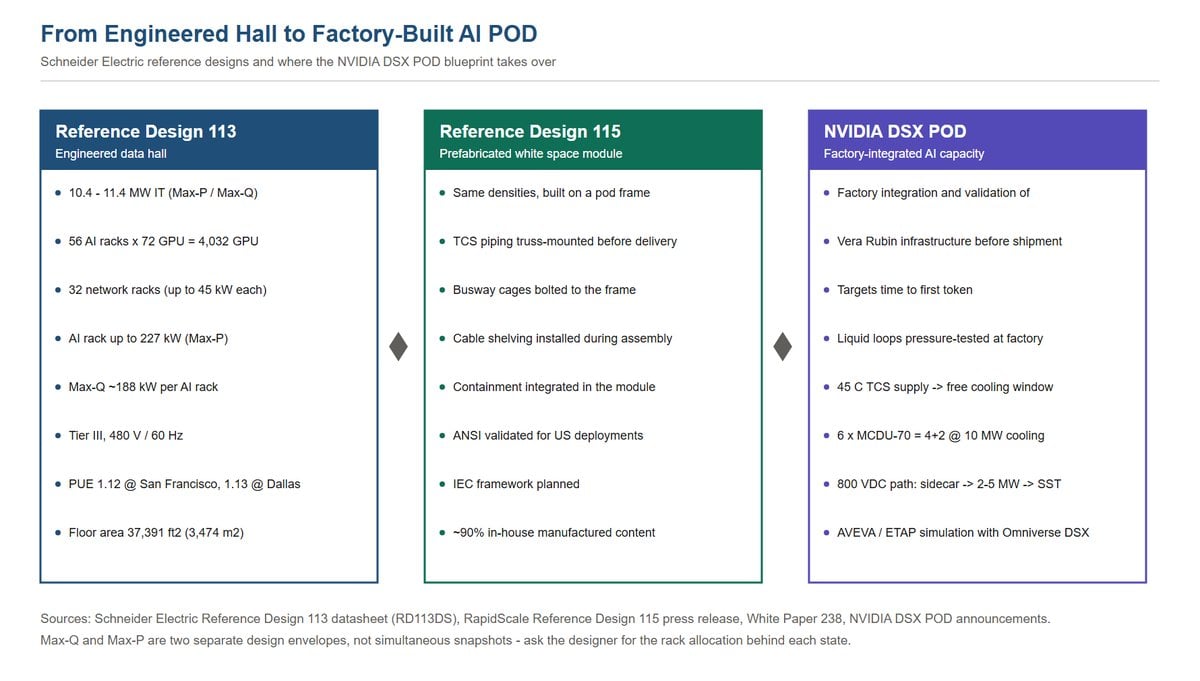
Fig. 1 — From engineered hall to factory-built AI POD. Left: Reference Design 113, a fully engineered 10.4–11.4 MW AI hall. Middle: Reference Design 115, the same density delivered as prefabricated white-space modules. Right: NVIDIA DSX POD, where factory integration and validation extend to the AI infrastructure itself. Max-Q and Max-P are two separate design envelopes, not simultaneous snapshots.
Rung one — Reference Design 113: the engineered hall. Published as a full datasheet with drawings, bills of material, schematics, and performance specifications, RD113 defines a purpose-built data hall for two NVIDIA Vera Rubin NVL72 clusters. Its published numbers deserve a close look because they define what "AI POD density" means in 2026 [5][6]:
|
Reference Design 113 parameter |
Value |
|
IT capacity (two operating states) |
10,414 kW (Max-P) – 11,408 kW (Max-Q) |
|
GPU count |
4,032 Vera Rubin NVL72 GPUs |
|
Rack complement |
56 AI racks + 32 network racks |
|
AI rack power density |
Up to 227 kW/rack (Max-P); ~188 kW/rack (Max-Q) |
|
Network rack density |
Up to 45 kW/rack (spline/management 15 kW, CME nodes 35 kW, CIN 45 kW) |
|
Target availability |
Tier III (concurrently maintainable) |
|
Regional power |
480 V, 60 Hz |
|
Data hall floor area |
37,391 ft² (3,474 m²) |
|
Annualized PUE at Max-Q |
1.12 (San Francisco) / 1.13 (Dallas) |
Table 1 — Reference Design 113 datasheet summary [5]. The GPU count cross-checks: 56 racks × 72 GPUs = 4,032. The Max-Q state also cross-checks on power: 56 AI racks × 188 kW = 10,528 kW, leaving 880 kW — about 27.5 kW average across the 32 network racks, comfortably inside the 15–45 kW per-rack band the datasheet assigns them.
The two operating states deserve a plain-language explanation because they are easy to misread. Max-Q is the efficiency envelope: all equipment active in an N+1 configuration, racks held near 188 kW where tokens-per-watt is maximized, giving 11.4 MW of IT capacity and a modeled PUE of 1.12–1.13. Max-P is the performance envelope: racks pushed to 227 kW for maximum output, with N equipment active and 10.4 MW of IT capacity. They are two design envelopes, not one snapshot — a hall cannot simultaneously be at 11.4 MW and have every AI rack at 227 kW. When a vendor quotes either number, ask for the rack-level allocation behind it.
Rung two — Reference Design 115: the prefabricated module. RD115 keeps the density target and changes the delivery method: TCS piping, busway, cable-support infrastructure, and containment are built onto a pod frame in a factory, aligned and inspected there, and shipped as a module. This is the rung the Compass time study measured — more on that below [1][2][3].
Rung three — DSX POD: the factory-validated AI factory. NVIDIA's DSX POD extends factory integration to the compute infrastructure itself — seven NVL72 racks per container, pre-cabled with 20 km of NVLink copper, validated and pressure-tested before shipment. Schneider's press release positions RD115 as the "foundational first step toward supporting the NVIDIA DSX POD reference design" [1]. We walked through what is inside a DSX container in our DSX POD deep dive; the relevant point here is that a DSX POD order is, from the facility side, a prefabricated module order with the factory boundary pushed one rung higher.
Reference Design 115's liquid-cooling architecture carries two numbers that will matter more to operators than any marketing headline.
The first is the technology cooling system supply temperature: up to 45°C [6]. Warmer TCS supply widens the free-cooling window dramatically — in most climates a 45°C loop can reject heat through dry coolers for most or all of the year without mechanical chilling. That is the same physics we covered in the DSX POD analysis (near-zero facility cooling water at 2 GW) and in our piece on how chilled-water supply and return targets are actually derived: the supply temperature you can defend is set by chip inlet limits minus loop gains and heat-exchanger approach, and every degree you buy back is free-cooling hours and chiller capex you never spend.
The second is the Motivair MCDU-70, a 2.5 MW coolant distribution unit introduced in January 2026 as the highest-capacity CDU in Motivair's (Schneider-owned) line, which now spans 105 kW to 2.5 MW [7]. The relevant arithmetic for a gigawatt-scale AI factory:
For context on where rack power is heading: the current reference designs top out at 227 kW per rack, but Schneider has already demonstrated an 800 VDC power infrastructure prototype developed with NVIDIA for the next generation — Rubin Ultra in the Kyber rack architecture, up to 576 GPUs and 1–1.2 MW per rack [6]. We analyzed why 800 VDC wins that current fight, and where its protection gaps remain, in our DSX POD power distribution piece. The short version for a 227 kW rack:
|
Delivery voltage |
Current per 227 kW rack |
Practical verdict |
|
480 VAC, 3-phase |
273 A/phase |
Standard for RD113/RD115 today |
|
415 VAC, 3-phase |
316 A/phase |
IEC-region equivalent |
|
800 VDC |
284 A |
Next-gen path; conversion moves out of the IT rack |
|
54 VDC (legacy rack bus) |
4,204 A |
Infeasible at this density |
Table 2 — Rack input current at 227 kW across delivery voltages (unity power factor, calculated). The jump from 227 kW racks to 1 MW Kyber racks is what forces the 800 VDC transition: at 54 VDC, 1 MW means over 18,500 amps of copper.
The figure doing the most work in Schneider's announcement is the Compass Datacenters time study, published October 16, 2026 as White Paper 238: Prefabricated White Space Module Time Study — Lessons from a High-Density Liquid-Cooled Deployment [2][3]. The methodology is more careful than most vendor time studies, which is exactly why it is worth dissecting.
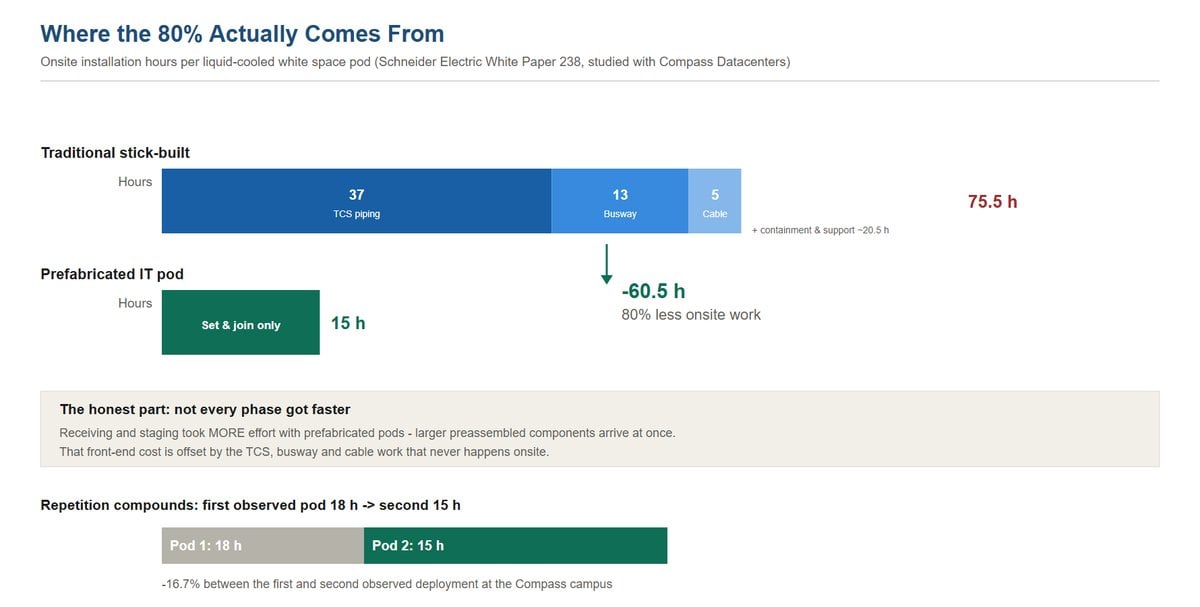
Fig. 2 — Where the 80% comes from. Traditionally, TCS piping (~37 h), busway (~13 h) and cable shelving (~5 h) are installed sequentially onsite — 55 of the 75.5 hours. In the prefabricated pod those systems arrive truss-mounted or frame-mounted and are simply set and joined: 15 hours. The second observed pod took 18 h; repetition brought it to 15 h.
What the study actually compared: the onsite activities required to make a white-space pod ready for IT equipment installation, at a Compass hyperscale campus. The prefabricated schedule used durations observed during a real deployment. The traditional comparison combined observed containment-installation durations with schedules developed by mechanical, electrical, and plumbing specialists for the equivalent TCS piping, busway, and cable-support work — a legitimate hybrid, but worth knowing about [2]. Three findings stand out:
Scaled honestly: 60.5 hours saved per pod only becomes a schedule story at pod quantity. Assuming 8 AI racks per white-space module — an assumption, not a published figure — a 56-AI-rack RD113 hall needs 7 modules. At 60.5 hours each, that is 423.5 hours of onsite labor avoided: about 53 eight-hour shifts for a single crew, roughly ten working weeks of a skilled-trades schedule compressed out of the critical path. Your pod count, rack-per-module ratio, and site logistics will move this number; the point is the shape of the saving, not the digits.
Also note what the study deliberately excludes: everything after installation verification, and all offsite manufacturing activity. The 80% is an onsite-hours claim, not a schedule claim. Factory build time, shipping, and site preparation run in parallel — that parallelism is where the real schedule compression lives — but White Paper 238 does not quantify it, and neither should a buyer's business case until they have their own schedule model [2][3].
Prefabricated everything only works if the factory exists. Schneider's announcement is as much a supply-chain statement as a product one: manufacturing capacity that has grown fourfold since 2025, eight primary manufacturing sites totaling 1.35 million square feet (about 125,400 m²), plus three additional facilities and 12 partner sites across 10 countries [1]. The company frames supply-chain management as "the new critical component in reducing scheduling uncertainty" — a notable shift for an industry that spent two decades treating construction trades as the bottleneck [1].
The demand backdrop Schneider cites: global data center capacity growing by roughly 170 GW by 2030 to about 300 GW total — 2.3 times the 2025 installed base — with AI workloads around 65% of demand by decade's end [1]. The arithmetic cross-checks: 300 GW ÷ 2.3 implies a 2025 base of about 130 GW, and 300 − 130 ≈ 170. Whether or not those exact figures land, the direction is not controversial; what is new is a major manufacturer betting that the response is factory throughput rather than construction management.
Competitively, third-party coverage places RapidScale against Vertiv's MegaMod and prefab power-cooling enclosures, Eaton, and Johnson Controls, with Schneider's differentiator being vertical integration — Galaxy V-series UPS, MasterPact breakers, and EcoStruxure software coming from inside the same portfolio rather than being integrated from third parties [8]. We buy and integrate equipment across all of these brands; in our experience the integration seams are where schedules slip, so a 90% single-vendor content claim is a real risk reducer — provided the factory acceptance testing is genuinely demonstrated, not asserted.
Every announcement leaves gaps, and this one has several that a serious buyer should write into their RFP:
Schneider Electric's RapidScale Reference Design 115 matters because it converts an argument — "prefabrication is faster" — into a measured, repeatable claim, and because it is the concrete bridge between the data halls operators build today and the factory-built AI factories NVIDIA announced this week. The 80% figure is real but narrow: 60.5 onsite hours per pod, concentrated in three trades, partly offset by heavier receiving, improving with repetition. The cooling stack — 45°C loops, 2.5 MW CDUs in 4+2 arrangements — is genuinely ahead of what most stick-built halls can absorb. And the ladder structure is the honest part of the story: RD113 tells you what good looks like, RD115 delivers it in factory-built modules, and DSX POD is where the whole industry is heading next.
If you are planning a high-density AI hall and want a second opinion on prefabricated versus stick-built scope split, CDU sizing, or the power architecture behind 227 kW-per-rack deployments, talk to our team — we build and integrate this class of equipment, and we will tell you where the factory boundary should sit for your site rather than quoting you a brochure.
Tell us your needs for data center infrastructure, and our team will provide you with customized green & energy-saving integrated solutions with global delivery and fast response.
 EN