 EN
Built for Outdoor Deployment Without Traditional Data Center Construction
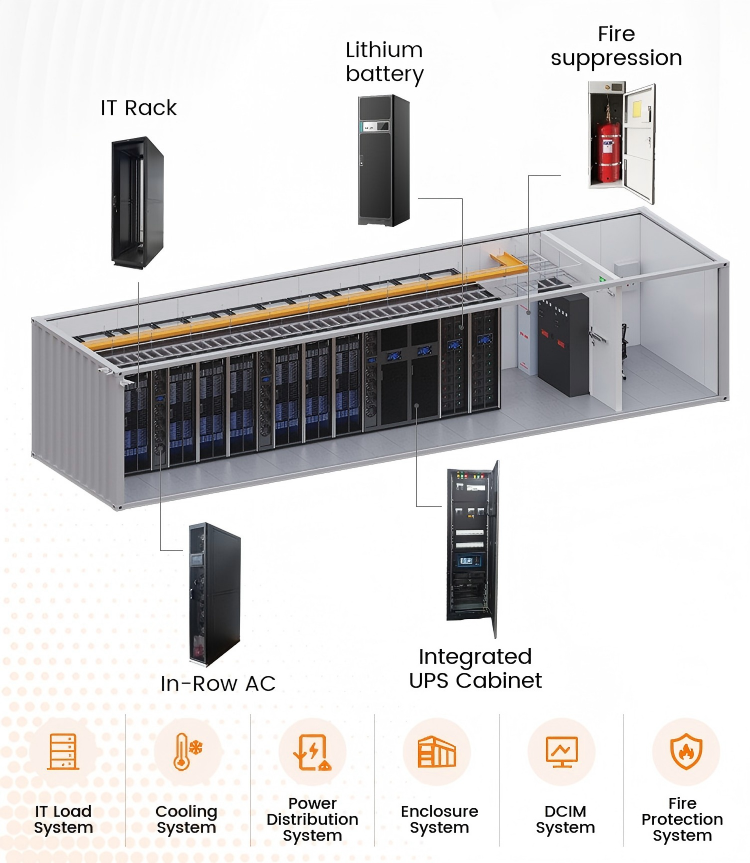
As digital infrastructure spreads out to remote sites, industrial zones and edge locations, businesses are hunting for more agile ways to roll out compute resources. Outdoor prefabricated data center pods deliver a workable answer. They pack IT space, power distribution, cooling hardware, monitoring tools and protective features all inside one factory-built enclosure.
Traditional data centers call for lengthy construction cycles and permanent building structures. Outdoor prefabricated pods cut through those barriers, making deployments feasible at sites where building standard facilities would prove difficult. All core infrastructure parts get put together and fully tested under controlled factory conditions before shipment. Once delivered to site, on site work boils down mostly to foundation setup, power hook up, network integration and final commissioning checks.
In practical outdoor projects, site conditions are often more challenging than expected. Remote locations may have limited construction resources, restricted maintenance access, unstable weather conditions, or strict project schedules. A prefabricated modular approach helps reduce onsite complexity by moving more integration work into the factory.
According to Uptime Institute’s guidance on prefabricated and modular data centers, modular solutions can help organizations deploy reliable computing infrastructure closer to users and business operations when design standards, testing processes, and operational requirements are properly coordinated. [1]
For this reason, outdoor modular solutions are increasingly considered for applications such as telecom stations, energy projects, industrial facilities, and edge computing locations. A well-designed outdoor data center needs not only computing capacity but also environmental protection, thermal management, security systems, and long-term operational reliability.
Integrated Liquid Cooling Supports AI and High-Density Computing Applications
The rapid development of artificial intelligence, machine learning, and high-performance computing has created new challenges for data center thermal management. Compared with traditional enterprise workloads, AI computing equipment generates higher heat loads and requires more advanced cooling strategies.
The AI Data Center Container (Liquid Cooling) solution combines prefabricated container design with liquid cooling technology to support modern AI infrastructure requirements. By integrating cooling systems, power infrastructure, IT space, monitoring systems, and protection features into one platform, it provides a more coordinated approach for deploying high-density computing environments.
Liquid cooling has become an important technology direction for advanced computing infrastructure because liquids can transfer heat more efficiently than air in certain high-density applications. ASHRAE highlights that increasing equipment heat density is driving wider adoption of liquid cooling approaches, including direct liquid cooling and liquid-cooled rack solutions, especially for demanding data center environments.
Cooling design carries even greater weight for outdoor based AI deployments. These field sites deal with swinging ambient temperatures, dust buildup, shifting humidity levels, and often limited on site maintenance support. A well engineered liquid cooling system keeps AI servers and high performance compute hardware operating within a stable thermal window.
Pairing an outdoor prefabricated data center pod with built in liquid cooling capability lets customers roll out AI compute resources right where data gets generated. This powers real world use cases including industrial AI, edge analytics, smart manufacturing and remote site data processing.
Factory Prefabrication Improves Quality Control and Project Delivery
One of the key advantages of a prefabricated data center solution is that major integration work can be completed before the equipment reaches the project site. Instead of installing multiple independent systems onsite, customers receive a more coordinated infrastructure platform.
During factory assembly, systems such as power distribution, cooling equipment, monitoring platforms, fire protection, and internal cabling can be integrated according to project requirements. Factory testing helps identify potential coordination issues earlier and improves confidence during final installation.
For EPC contractors and system integrators, this delivery model changes the traditional construction workflow. Site teams can focus on installation, utility connections, and commissioning instead of managing every individual equipment installation process.
Based on practical experience in modular infrastructure projects, remote deployment locations often create additional challenges related to transportation, technical support, and onsite coordination. A factory-integrated approach can reduce these uncertainties by providing a more standardized delivery process.
The outdoor prefabricated data center pod design also supports future expansion. Organizations can start with the computing capacity required for current operations and add additional modules when business demand grows. This flexibility is valuable for industries where digital infrastructure requirements continue to change.
Designed for Telecom Stations, Remote Sites, and Edge Computing Infrastructure
The growth of edge computing is changing how organizations deploy digital infrastructure. Instead of sending all data back to centralized facilities, more companies are placing computing resources closer to users, equipment, and production environments.
Telecommunication operators are one of the major application areas for outdoor modular data centers. Base stations, 5G networks, and regional communication nodes require compact infrastructure that can operate reliably in distributed locations. An outdoor prefabricated data center pod provides a dedicated environment for communication equipment, edge servers, and network applications.
Industrial sectors also benefit from outdoor deployment solutions. Manufacturing plants, mining operations, energy facilities, and remote infrastructure projects often require local computing capability for automation, monitoring, and data analysis. Building a traditional data center in these environments may involve significant construction challenges, while modular solutions provide a more flexible alternative.
For AI infrastructure customers, container-based solutions create new possibilities for deploying computing resources outside traditional data center campuses. The combination of liquid cooling, integrated power systems, and modular architecture allows AI computing capacity to be positioned closer to operational sites.
These characteristics make outdoor modular data centers suitable for a wide range of scenarios, including edge computing, industrial intelligence, remote monitoring, disaster recovery, and temporary computing projects.
Why Choose an Integrated Outdoor Prefabricated Data Center Pod Solution
Selecting an outdoor data center solution requires more than choosing hardware capacity. Customers need to consider environmental adaptability, system integration capability, cooling architecture, reliability planning, and long-term maintenance requirements.
A professional outdoor prefabricated data center pod provider should support the complete project process, including solution design, factory manufacturing, system integration, testing, delivery support, and technical service.
ZTMMDC’s AI Data Center Container (Liquid Cooling) solution is designed to address these requirements by combining modular manufacturing with advanced cooling technology and integrated infrastructure design. The solution is suitable for customers who need flexible AI computing deployment, edge infrastructure expansion, and outdoor data center applications.
As AI workloads and distributed computing continue to grow, outdoor modular data center solutions provide organizations with another option for building scalable digital infrastructure without relying only on traditional facilities.
For companies planning telecom expansion, industrial digitalization, or AI computing deployment, choosing the right modular data center partner can help improve project efficiency, reduce deployment complexity, and create a reliable foundation for future growth.
Frequently Asked Questions
What is an outdoor prefabricated data center pod?
An outdoor prefabricated data center pod is a factory-built modular infrastructure unit that integrates IT space, power systems, cooling equipment, monitoring, and protection functions into an outdoor-ready enclosure.
Where are outdoor prefabricated data center pods used?
They are commonly used in telecom stations, industrial sites, energy projects, remote locations, edge computing environments, and AI infrastructure deployments.
Why is liquid cooling used in AI data center containers?
Liquid cooling helps manage the increasing heat generated by high-performance computing equipment and provides an effective thermal management option for AI and HPC applications.
How does prefabricated design simplify deployment?
Because major systems are integrated and tested before delivery, onsite work mainly focuses on installation, connection, and commissioning, reducing project coordination complexity.
Can outdoor modular data centers support future expansion?
Yes. Modular designs allow organizations to increase infrastructure capacity according to changing computing requirements, making them suitable for long-term edge and AI infrastructure development.
[1]TIER-Ready Pre-Fabricated and Modular Data Centers- Uptime Institute
Table of Contents
- Built for Outdoor Deployment Without Traditional Data Center Construction
- Integrated Liquid Cooling Supports AI and High-Density Computing Applications
- Factory Prefabrication Improves Quality Control and Project Delivery
- Designed for Telecom Stations, Remote Sites, and Edge Computing Infrastructure
- Why Choose an Integrated Outdoor Prefabricated Data Center Pod Solution
- Frequently Asked Questions