 EN
Why a Modular Data Center Containment System Needs More Than Physical Barriers
A modular data center containment system is more than roof panels, doors, and side barriers. Its main objective is to manage the flow of supply air to IT equipment and the return of heated exhaust air to the cooling equipment. Poor management can cause cold air to bypass the IT equipment and/or cause hot exhaust air to mix with supply air. As a result, individual equipment racks can get hot spots, and the overall data center may still be cooled sufficiently. When designing modular data centers, all of the equipment must be carefully integrated to ensure it fits within a defined footprint. The modular data center containment system should be designed to manage the flow of hot and cold air, while still allowing the data center technicians to have access to the equipment for the purpose of installation of cabling, equipment replacement and maintenance. The system should also facilitate flow for first responders in the event of an emergency. Containment should be designed to work in conjunction with the actual flow of the air, the dimensions of the server racks, the placement of the equipment and the cooling units. ZTMMDC is modular data center company that implements hot or cold aisle containment in its data center designs. ZTMMDC integrates these containment systems with other modular data center elements such as racks, cooling, power distribution, fire suppression, and control/monitoring systems. This company’s approach is beneficial when modular data center designs have space constraints and need to be flexible to grow computing capacity.
It relies on many factors including how the system is commissioned and operated. This includes how the seals are installed between panels, the balance of the airflow and control of the cooling, the arrangement of the equipment and how the system is operated. The aim is to create a stable, predictable thermal environment, as opposed to simply enclosing a row of racks.
Structural Design, Panel Sealing, and Practical Installation Details
Designing a modular data center containment system requires consideration of many factors beyond the weight of the panels. Engineers must think about the placement of the support locations, the movement of the doors, the alignment of the panels, openings for controls and cables, the loads created during the installation and maintenance, overhead and suspended panels and components, and the serviceability of the hinges and latches of access panels. Seismic conditions and special fire safety provisions require a more thorough review of the structure, connections, supports, and the configuration of the containment system. There is no one containment configuration that satisfies every site requirement. Therefore, engineers must analyze gaps and interfaces at the ceiling, the enclosure, and equipment rack tops and ends.
Unsealed openings allow return and supply air to mix, decreasing the effectiveness of containment. Obstructing required ventilation and access for maintenance and building safety systems is unacceptable. Balancing these competing requirements requires the integration of the containment supplier, cooling and electrical engineers, fire protection engineer, and other stakeholders into the design review. For a factory integrated modular data center, some of these interfaces can be evaluated prior to shipment and help to reduce the need for improvised changes at the site.
The modular data center's containment system, upon delivery to the site, must be evaluated for sealing continuity, door operation, alignment and fastening of panels, and integrity of seals, etc. before racks are installed. The final configuration of the racks must be aligned with the fire protection and other building safety systems. It is more prudent to assume that a collection of individual, interrelated, and integrated components do not automatically ensure an overall system complies with the requirements.
Using Airflow Analysis and CFD to Find Thermal Risks Before Deployment
CFDIM involves various tools to simulate and optimize systems including data center cold aisles. These tools allow engineers to determine where the hot spots are most likely to occur and how airflow is distributed throughout the data center. Engineers have to input a lot of detail in the CFD simulation in order to get accurate results. If the model takes heat loads as being uniform across all racks, and in the actual environment there are a couple of racks with a lot of high density servers, then that model will not accurately simulate the most likely failure scenario. CFD modeling allows engineers to simulate realistic scenarios such as air bypassing and partially filled racks. They can determine the airflow through the racks as well as the airflow through the supply and return paths. Using these tools, engineers can evaluate the system under expected peak conditions and determine what occurs if a cooling unit goes offline. These tools will help determine where the “thermal” hot spots will occur in the data center.
The chapter in the ASHRAE Handbook on data centers and telecommunications facilities explains that CFD can help predict cooling performance. However, this depends on the accuracy of the CFD model in representing the space and the devices that influence airflow. This is a critical limitation. An overly complex and visually detailed simulation will not be reliable merely because it is using an advanced software package. Imagine an engineering review of a modular edge data center. Two racks in the data center have significantly higher heat loads compared to the other racks, and containment has been requested to remedy the issue.
Useful comparisons should be made between the rack heat map and placement of the cooling units. It should analyze recirculation near the top of the racks and near the ends of the rows. It should analyze whether the supply airflow meets the inlets of the server. The containment should be modified based on the predicted results and checked against measured results during commissioning. If temperature sensors at representative rack inlets and cooling unit alarms are queried, the team can evaluate whether the modeled conditions represent the actual conditions.
Integrating In Row Cooling with the Containment Architecture
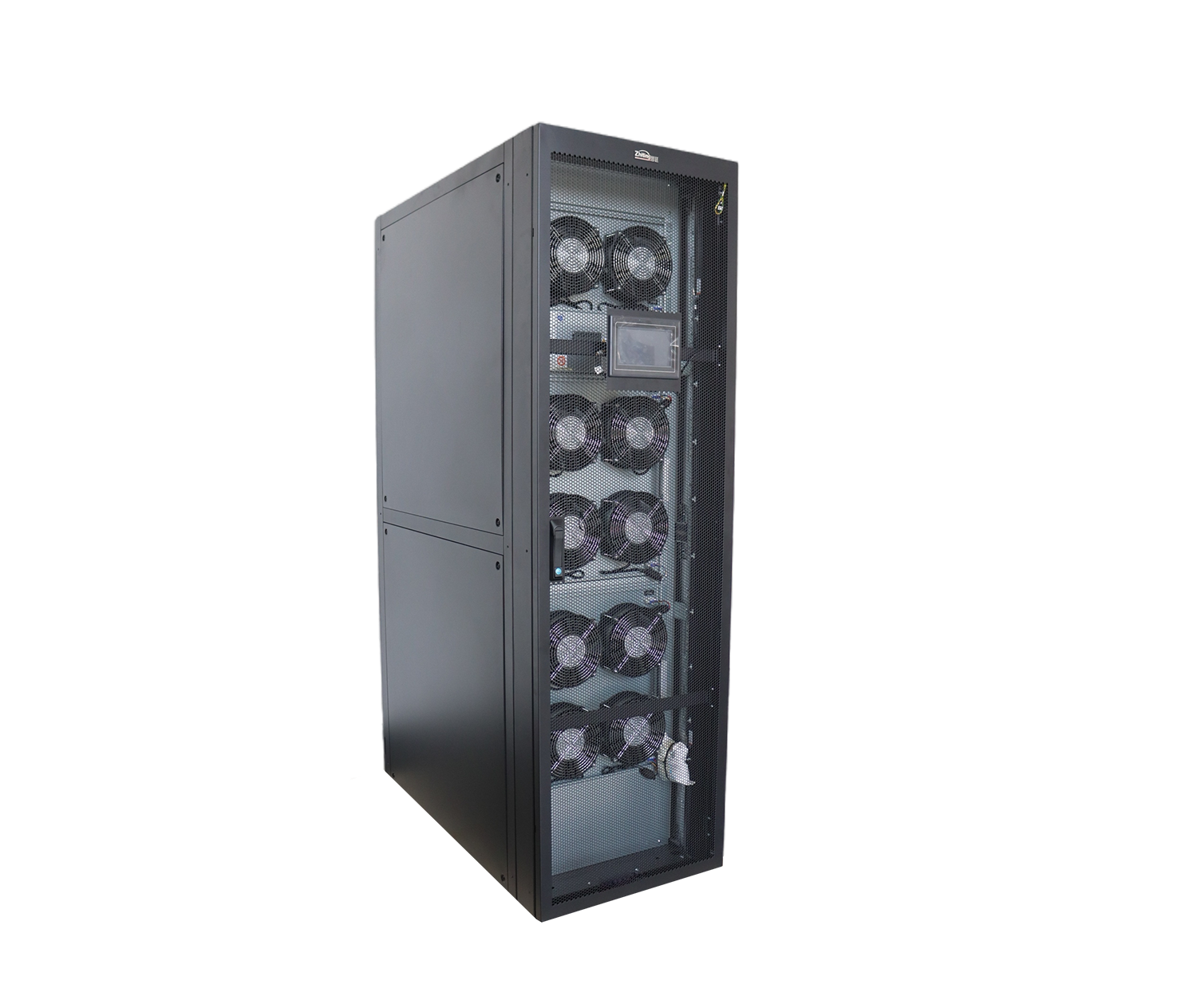
Containment and cooling must be integrated as a single thermal management system. A modular data center containment system can separate supply air from hot exhaust, but cannot account for inadequate cooling capacity, wrong airflow direction, and poorly designed controls. ZTMMDC’s HM Series In Row Cooling brings precision cooling units between server racks, thus decreasing the distance that supply air needs to travel. It’s designed for medium to high density data center applications and can be configured using direct expansion or chilled water, depending on the model selected. Published specification sheets indicate a cooling range of 15 to 62.6 kW for the ZT HM12R to 60R range and 32.9 to 61.4 kW for the chilled water ZT HM30RC to 80RC range. Actual selection should be dependent on the model, the operating conditions, the cooling requirement, and the expected heat load at the site.
EC fans with stepless control and variable frequency compressors are available on certain models and come with a 7 inch touchscreen. These fans can be connected via CAN bus for group control up to 32 units and have features for diagnostics and service. Dual power supplies and water leak sensors are available as options. The units are modular and can be configured for top, front or side airflow, however the configuration should be based on the air intake and exhaust of the equipment and the containment layout. During integration, the positioning of the cooling units and coordination of service clearances should also be considered with regards to condensate management and electrical connections, sensors and control.
The engineers should determine how the cooling system responds to changes in IT load and whether the monitoring system can detect abnormal inlet temperatures and cooling alarms and identify communication faults. During a design review, the engineers would ensure that maintenance can be performed on the racks without disturbing adjacent equipment and that the airflow paths are adequate. The final system should be validated with functional checks and site commissioning rather than assuming that the system is operating as intended with nominal cooling capacity.
Factory Integration, Commissioning, and Long Term Performance Verification
A dependable modular data center containment system should be evaluated throughout design, factory integration, shipment, and site commissioning. During factory integration, inspection should evaluate dimensions of panel openings and fasteners, alignment of hinges and door closure, access clearances, sensor and cooling unit interfaces, cable routing, assembled layout consistency with approved drawings, and test operation of the containment and cooling systems. Where the systems are provided as a unit, the test plan should assess functions of the system that can be demonstrated prior to shipment and what is dependent on site conditions and the state of the integrated IT systems. Basic cooling and control operations can be tested prior to shipment, but final room temperature and airflow distribution may be dependent on site conditions. After installation, commissioning should evaluate panel seals and door operation, cooling unit operation, and if the inlet air temperature of the racks is within the limits specified for the IT equipment. Thermal checks should be performed whenever possible and relevant operating conditions should be documented. If the site has different operating modes, commissioning should be performed under the most demanding conditions.
The Uptime Institute outlines key strategies for the management and improvement of data center cooling systems. These focus on the management of airflow, monitoring, and methodology. These are relevant when assessing modular data centers, and while a well-engineered modular data center may be more efficient compared to traditional construction, many of the same principles still apply. It is also advisable to retain documentation such as approved drawings, schedules of cooling equipment, test records, sensor locations, alarm settings, and maintenance instructions.
There are numerous real-world examples where the assumption of optimal system performance following an occupancy change resulted in issues that became immediately apparent following an upgrade to a different rack. During the evaluations of modular data centers, a configuration-specific, containment-based layout of the cooling system and associated rationale, documentation of key components, inspection records from the factory, procedures for commissioning, and a clear definition of the customer’s responsibilities are the most valuable evidence provided by the supplier. ZTMMDC and the HM Series In Row Cooling are some of the products that may be of assistance for projects that require a modular, integrated data center and cooling solution. In all cases, actual system performance must be compared to the design, equipment installed, operating conditions, and tests done.
Frequently Asked Questions
Q1: What does a modular data center containment system do?
It separates supply and return airflow paths to reduce unwanted mixing, help deliver cooling air to server inlets, and manage hot exhaust air. Its performance depends on the rack layout, sealing, cooling design, and operating controls.
Q2: Is hot aisle containment better than cold aisle containment?
Neither arrangement is universally better. The right choice depends on the cooling architecture, rack layout, maintenance requirements, fire protection design, and the way the facility will operate.
Q3: Why is CFD analysis useful for modular data centers?
CFD can identify potential hot spots, bypass airflow, and exhaust recirculation before deployment. Its predictions depend on accurate geometry, heat load data, airflow assumptions, and suitable validation.
Q4: How does in row cooling support containment?
In row cooling places cooling equipment close to the server racks. When properly coordinated with containment and airflow direction, it can help address localized heat loads and reduce unnecessary air travel.
Q5: What should buyers verify before accepting the system?
Review the approved layout, panel sealing, door operation, cooling capacity, airflow configuration, monitoring functions, factory test records, and commissioning results under representative operating conditions.
Table of Contents
- Why a Modular Data Center Containment System Needs More Than Physical Barriers
- Structural Design, Panel Sealing, and Practical Installation Details
- Using Airflow Analysis and CFD to Find Thermal Risks Before Deployment
- Integrating In Row Cooling with the Containment Architecture
- Factory Integration, Commissioning, and Long Term Performance Verification
- Frequently Asked Questions