 EN
Tropical Data Center Cooling: Start With Site Conditions
Quick Answer
| A tropical or high-ambient data center cooling system should be selected from the rack-by-rack load, approved site weather file, indoor operating envelope, room dew point, water constraints and final heat-rejection duty. Do not select it from rack density alone. |
ZT's first-pass cooling bands are:
- 5–8 kW/rack: N+1 in-row air conditioning;
- 15–30 kW/rack: in-row cooling with airflow containment;
- 30–50 kW/rack: rear-door heat exchange or a hybrid air/liquid arrangement;
- above 50 kW/rack: chip-level liquid cooling as the practical path;
- 100+ kW/rack: project-specific liquid cooling with residual air cooling checked separately.
| The bands identify an architecture to investigate. Actual equipment duty still has to be checked at the project's entering-air, entering-water and outdoor design conditions. |
Field Note: The Weather File Is a Design Input
A request often arrives with two lines: “tropical site” and “high ambient.” Neither is an equipment duty point.
Use the approved project weather file. Dry bulb affects air-side and heat-rejection equipment; wet bulb matters where evaporation is involved; humidity sets dew-point risk. Dust, salt exposure and water constraints may also change the selection. Do not copy climate values from another city or a generic brochure.
ASHRAE's Datacom Series provides thermal guidance, while Singapore's IMDA Green Data Centre Roadmap provides policy context. Project weather data and IT operating limits still govern the design.
Design Inputs to Put on One Sheet
Mark unknowns as open rather than hiding them in assumptions.
IT and rack inputs
- equipment and peak load in each rack;
- server airflow and allowable inlet conditions;
- cold-plate coverage and residual air load;
- rack weight, service clearance and growth load.
Site and utility inputs
- approved dry-bulb, wet-bulb and humidity data;
- indoor environmental envelope;
- water availability, chemistry and restrictions;
- redundancy, outdoor exposure and heat-rejection location.
Control and commissioning inputs
- dew-point sensors and coolant reset logic;
- leak alarms, isolation and drain strategy;
- test loads, acceptance criteria and energy-monitoring points.
Rack Load First, Then the Cooling Route
| Declared rack load | First route to review | Main high-ambient checks |
| 5–8 kW/rack | N+1 in-row air conditioning | Coil duty, recirculation, filtration, outdoor heat rejection |
| 15–30 kW/rack | In-row cooling plus containment | Rack heat map, aisle leakage, fan duty, humidity control |
| 30–50 kW/rack | Rear-door exchanger or hybrid air/liquid cooling | Air/liquid heat split, water temperature, condensation controls |
| Above 50 kW/rack | Chip-level liquid cooling | Cold-plate coverage, CDU duty, residual air load, heat rejection |
| 100+ kW/rack | Project-specific liquid-cooled design | Manifold layout, maintainability, redundancy, integrated testing |
Read this as a screening table, not a selection schedule. A dense rack with only part of its heat captured by cold plates can still place a substantial load on room air. Conversely, a lower-density room with poor containment can develop inlet-temperature problems even when total cooling capacity appears adequate.
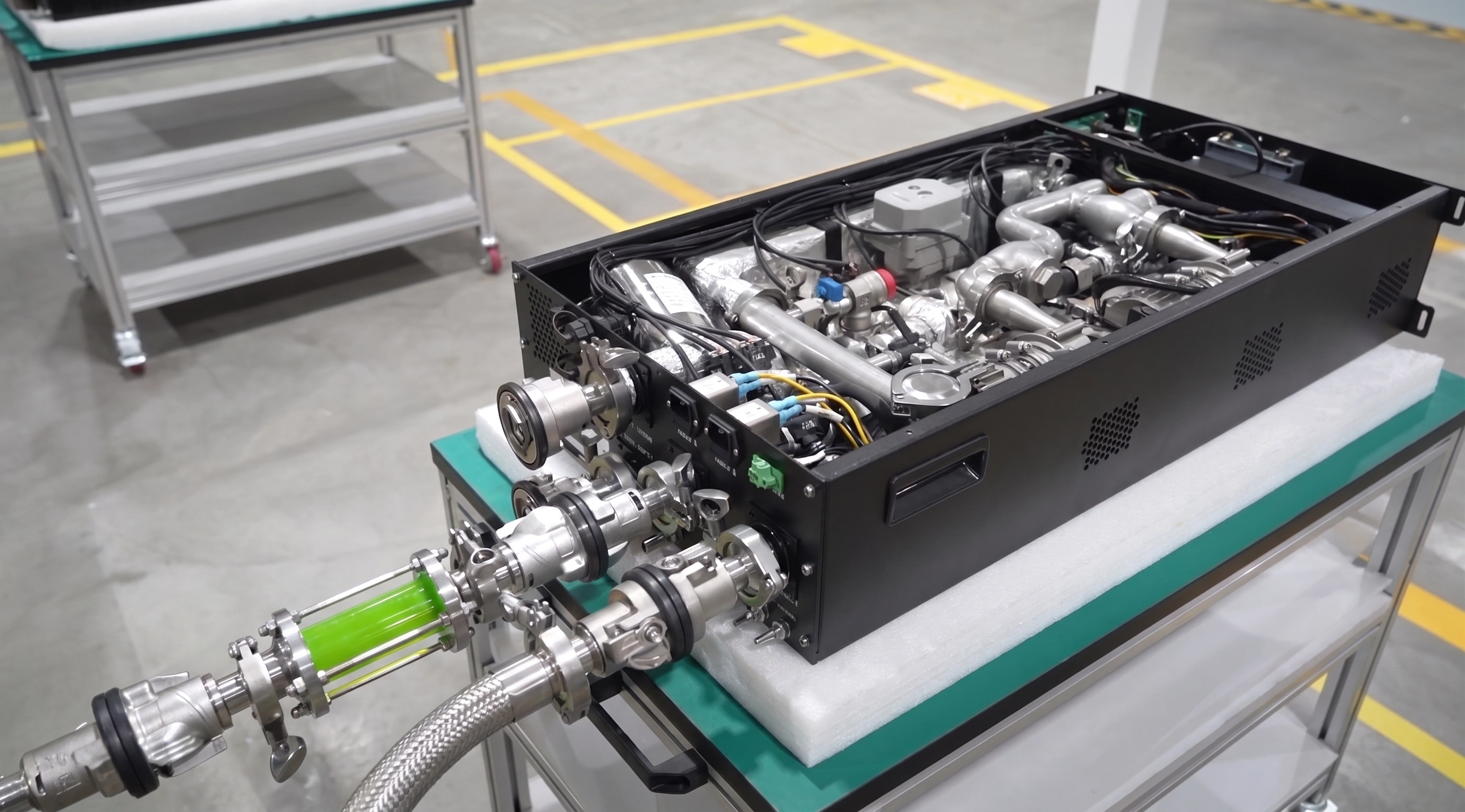
ZT's liquid-cooled racks support 30 kW to 100 kW+, using 304 stainless-steel manifolds, EPDM hoses and dry-break quick connectors. Verify coolant compatibility and pressure boundaries.
A Short Load Check From a Project Record
Use rack-level arithmetic before discussing equipment quantities. ZT's Kazakhstan reference used three 40-foot containers with 168 kW total IT load across 24 racks:
|
Average rack load = 168 kW ÷ 24 racks = 7 kW/rack |
That result sits in the 5–8 kW/rack band, where the project used N+1 in-row air conditioning. The calculation does not prove that every rack was exactly 7 kW. The rack schedule still controls local airflow and unit placement.
The same caution applies to a standard 40-foot arrangement. 40–70 kW is the total container IT capacity, not the rack density. In the documented 40 kW across eight racks arrangement, the result is 5 kW/rack.
Whole-container load, rack load, cooling-unit capacity and CDU thermal capacity are different quantities. Keep separate columns for them.
Dew Point: Make the Control Decision Explicit
Condensation risk is not solved by writing “humidity control” in the specification.
First, identify every surface that can be cooled by the technology loop: cold plates, hoses, manifolds, quick connectors and exposed pipework. Then compare the minimum expected surface or coolant temperature with the room dew point under normal operation, start-up, door opening, control failure and maintenance conditions.
The control narrative should answer four questions:
- Which sensors establish the room dew point?
- How much separation is required between dew point and coolant supply temperature?
- Does the CDU reset temperature, issue an alarm, restrict load or stop flow when the limit is approached?
- What happens if a humidity or temperature sensor fails?
The answers are project-specific. They must align with the IT hardware limits. Avoid inserting an arbitrary dew-point margin merely because it appeared in another design.
Insulation can reduce surface exposure, but it is not the only control. Joints, valves and service connections remain vulnerable. Commissioning should challenge the sensor logic and alarm sequence rather than checking only steady operation.
CDU and Residual-Air Checks
The CDU separates and controls the facility and technology loops. ZT's CDU range is 200–1400 kW, with secondary-side temperature control to ±1°C. An available 1+1 arrangement covers pumps, instruments, power and communications.
A procurement schedule should state thermal duty at declared loop conditions, coolant and wetted materials, flow, pressure, filtration, controls, the component-level meaning of 1+1, electrical feeds, isolation and leak detection. It must also state heat rejected by non-cold-plated components. A liquid cooling data center still needs an air-side load calculation.
Air-Side Equipment Notes
ZT lists direct-expansion in-row units from 15 to 62.6 kW and chilled-water units from 32.9 to 61.4 kW, with a sensible heat ratio above 95%. Nameplate capacity is not selected duty. Request performance at project conditions, apply redundancy, and check the hottest rack during maintenance.
Containment needs a drawing showing blanking, cable openings and air paths. ZT racks provide 80%+ perforation and a 3000 kg static-load rating, subject to confirmation for the offered rack.
Procurement Cross-Check
Before accepting a supplier proposal, check the following line by line:
- rack loads are listed individually, not only as an average;
- the weather source and design conditions are named;
- equipment capacities are stated at project duty points;
- air-side and liquid-side heat loads reconcile with the IT total;
- redundancy is described as a topology, with covered components identified;
- dew-point logic includes sensor failure and start-up states;
- CDU materials, coolant, filtration and connectors are compatible;
- heat-rejection equipment includes pumps, controls and auxiliary loads;
- factory tests cover alarms, interlocks, leaks and loss of a redundant component;
- certificate numbers and scopes match the exact offered configuration.
ZT lists ISO 9001, CE, CCC, TUV, RoHS, UL and TIA-942 among its certifications. Verify the scope for the offered assembly.
PUE: State the Boundary Before the Number
ZT recorded annual PUE below 1.2 for full cold-plate liquid-cooling capability in 2024; its library lists 1.5–2.0 for traditional air-cooled facilities. These are bounded records, not a tropical-site guarantee.
State whether PUE is measured or modeled, annual or instantaneous, and which auxiliary loads are inside the boundary. Also state load profile, weather basis and heat-rejection sequence. See the Green Grid PUE resource. Final targets need project-specific review and an agreed measurement plan.
FAQs
What is the best cooling system for a tropical data center?
There is no single best system. Select the first architecture from rack density, then verify it against site weather, humidity, water constraints, IT limits, redundancy and heat-rejection duty.
Can in-row air cooling serve AI racks?
ZT reviews in-row cooling with containment at 15–30 kW/rack. At 30–50 kW/rack, review rear-door or hybrid cooling. Above 50 kW/rack, chip-level liquid cooling is the practical path.
Does direct-to-chip cooling remove the need for room cooling?
Usually not. Components outside the cold-plate circuit may reject heat to air. Quantify that residual load from current IT data sheets.
How should dew-point risk be checked?
Compare the lowest expected coolant or surface temperature with room dew point across normal, start-up, fault and maintenance states. Document sensor locations, reset logic, alarms and failure actions.
What CDU capacities does ZT list?
ZT lists 200–1400 kW CDUs, secondary-side temperature control to ±1°C, and an available 1+1 arrangement for pumps, instruments, power and communications.
Can ZT guarantee annual PUE below 1.2 at a hot site?
No universal guarantee follows from the recorded result. ZT achieved annual PUE below 1.2 for full cold-plate liquid-cooling capability in 2024, but a project target needs a defined boundary, weather basis, load profile, system model and measurement method.
What should a buyer send for the first engineering review?
Send the rack schedule, hardware list, air/liquid heat split, operating limits, approved weather data, water information, redundancy requirement, site layout and preferred heat-rejection approach.
Three Takeaways
- Use the approved weather file and rack schedule. “Tropical” and average rack kW are not sufficient design inputs.
- Treat dew point as a control sequence. Identify sensors, limits, reset actions, alarms and failure states.
- Reconcile the whole heat path. IT load, residual air load, CDU duty and outdoor heat rejection must agree before equipment is ordered.
About ZT
Founded in 2009, ZT (ZheJiang ZhiTing Information Technology Co., Ltd) designs and manufactures prefabricated data center infrastructure from a 30,000 m² production facility in Zhejiang, China, with 200+ staff. ZT manufactures CDUs, in-row cooling, UPS, racks and DCIM, and offers the NEBULA SERIES liquid-cooled micro-module. Certifications include ISO 9001, CE, CCC, TUV, RoHS, UL, and TIA-942.
Discuss the Design Inputs With ZT
Send the rack list, IT operating limits, weather file, water information, redundancy target and heat-rejection constraints. ZT's engineering team can review the air, hybrid or liquid-cooling route against those declared inputs.
Request a technical consultation, review ZT's liquid-cooling products, or see the containerized data center solution.
Sources
Table of Contents
- Tropical Data Center Cooling: Start With Site Conditions
- Quick Answer
- Field Note: The Weather File Is a Design Input
- Design Inputs to Put on One Sheet
- Rack Load First, Then the Cooling Route
- A Short Load Check From a Project Record
- Dew Point: Make the Control Decision Explicit
- CDU and Residual-Air Checks
- Air-Side Equipment Notes
- Procurement Cross-Check
- PUE: State the Boundary Before the Number
-
FAQs
- What is the best cooling system for a tropical data center?
- Can in-row air cooling serve AI racks?
- Does direct-to-chip cooling remove the need for room cooling?
- How should dew-point risk be checked?
- What CDU capacities does ZT list?
- Can ZT guarantee annual PUE below 1.2 at a hot site?
- What should a buyer send for the first engineering review?
- Three Takeaways
- About ZT
- Discuss the Design Inputs With ZT
- Sources