 EN
The 40-Foot Envelope: More Than Just a Shipping Box
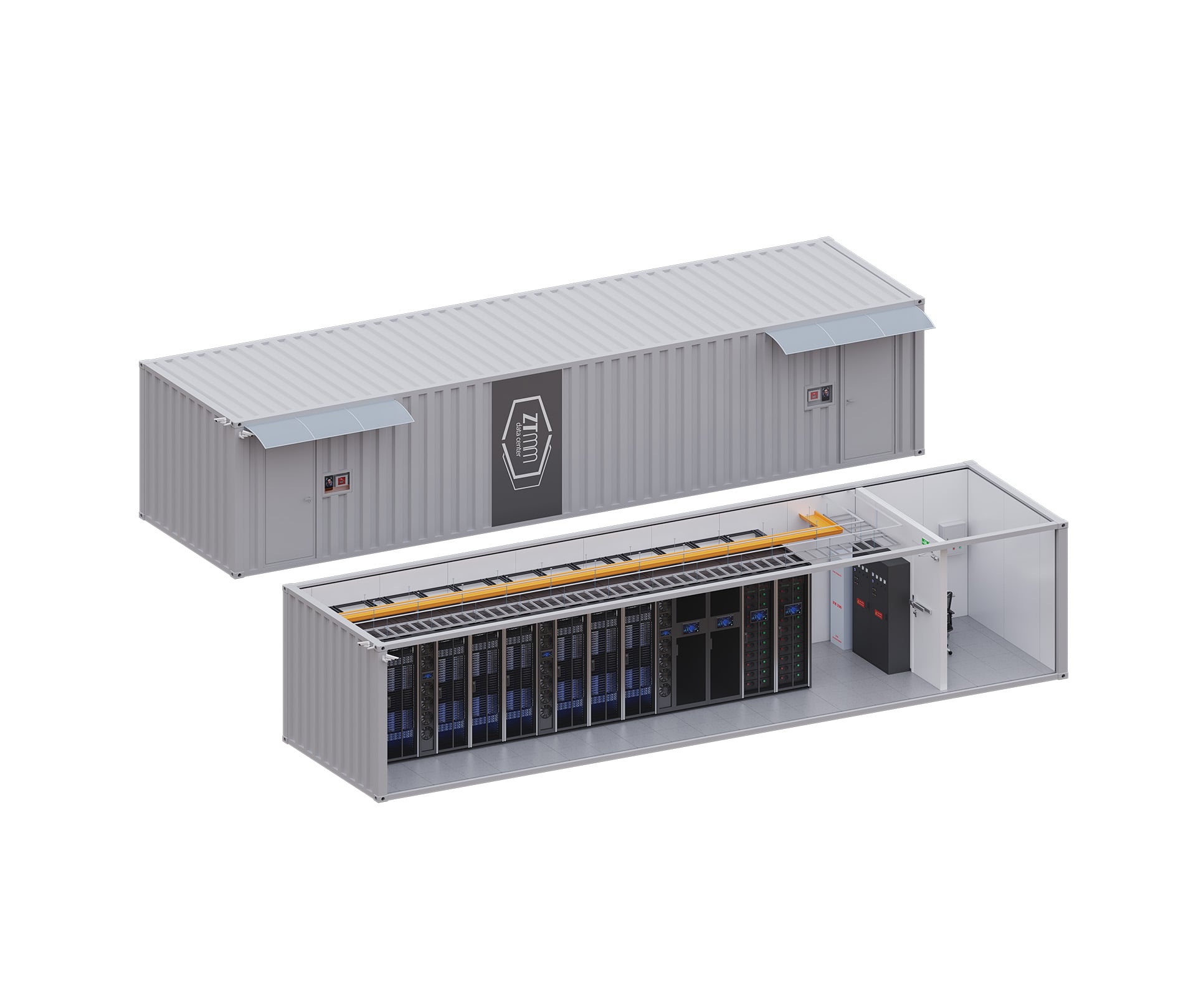
A standard 40-foot high-cube ISO container measures 12,192 mm in length, 2,438 mm in width, and 2,896 mm in height. On paper, that is 320 square feet of footprint. In practice, the usable interior space shrinks further once insulation, raised flooring, and equipment mounting structures eat into the dimensions. The real question is not whether IT equipment fits—it usually does, with room for eight to twelve racks depending on configuration. The real question is whether the structure can handle the weight, the vibration from transport, the stack loading if units are deployed in multi-tier configurations, and the thermal expansion that comes with outdoor siting.
A 40-foot container shell alone weighs roughly 4.2 metric tons. Fully populated with racks, servers, UPS systems, cooling units, and cabling, the total weight can exceed 20 tons depending on the configuration. During lifting and transportation, loads are transferred through the corner castings and structural frame, while internal IT equipment creates additional concentrated loads that must be carefully evaluated.
Structural reinforcement should be determined based on actual equipment weight, point loads, center of gravity, lifting and transportation loads, seismic requirements, stacking conditions, and site-specific structural calculations.
For example, an engineering evaluation may identify the need for additional structural support, such as reinforced roof structures, improved load distribution components, or frame enhancements, to ensure that high-density equipment is safely supported. The key consideration is that standard ISO containers provide the basic enclosure framework, but containerized data centers require application-specific structural design.
Stacking, Seismic, and Site Constraints
Stacking containers in multi-tier deployments introduces another layer of structural complexity. ISO containers are rated for stacking when loaded uniformly, but data center configurations concentrate mass unevenly—cooling units on one end, batteries in another, racks distributed asymmetrically. The center of gravity shifts. Without careful load distribution planning, the lower containers in a stack can experience localized overstress at points not designed for such concentrated loading.
Seismic performance adds yet another constraint. Containers deployed in active seismic zones need more than standard corner castings. Some products on the market carry seismic certifications such as YD5083 Intensity 8. That rating does not come from the stock container—it requires structural reinforcement, bracing, and often additional welding at key stress points. The ANSI/TIA-942 and ISO/IEC 22237 standards provide frameworks for data center construction, but containerized implementations demand interpretation and adaptation because the standard container envelope was never intended as a permanent critical infrastructure housing.
Site selection also matters. A 40-foot container weighing over 20 tons cannot sit on just any pad. Floor loading capacity must be verified. Ground conditions determine whether additional earth rods or foundation work is needed. These are not optional considerations—they are prerequisites that separate successful deployments from expensive corrective exercises.
The Thermal Challenge: Packing Heat into a Steel Box
The structural constraints are straightforward compared to the thermal problem. A 40-foot containerized data center may support different IT load levels depending on rack density, cooling architecture, and project requirements. Concentrating high-density computing equipment inside a compact steel enclosure creates a thermal environment that is fundamentally different from a traditional data center hall.
The limited internal space of a container leaves less room for airflow optimization. Without proper airflow management and thermal design, cold supply air and hot exhaust air can mix, reducing cooling effectiveness and increasing overall energy consumption. Thermal characteristics of the container enclosure can also influence heat absorption and dissipation, making cooling performance dependent on both system design and operating conditions.
Outdoor deployment introduces additional challenges. Depending on design and project requirements, outdoor systems may need to operate across a wide ambient-temperature range. Humidity, dust, and corrosive elements in coastal or industrial environments can increase operational stress and affect cooling system reliability. Proper filtration, environmental protection, and regular maintenance planning are important for maintaining long-term performance.
Airflow Architecture: Cold Aisle, Hot Aisle, and Containment
The industry standard approach to managing airflow in containerized data centers mirrors the strategies used in traditional facilities: separate cold supply air from hot exhaust air using aisle containment. Cold-aisle containment (CAC) and hot-aisle containment (HAC) both work, but the constrained geometry of a 40-foot container makes implementation more demanding.
Computational fluid dynamics (CFD) modeling has become an important tool for validating airflow and thermal designs before fabrication. CFD can reveal recirculation zones and localized hotspots before fabrication, allowing airflow paths, cooling layouts, and containment details to be optimized.
By simulating different operating conditions, engineers can evaluate airflow distribution, identify potential thermal risks, and improve cooling system design before physical deployment. For containerized data centers, CFD analysis helps ensure that limited internal space is used efficiently while maintaining stable operating conditions for high-density IT equipment.
The choice between cold-aisle and hot-aisle containment depends on cooling system architecture, rack density, and site conditions. Cold-aisle containment tends to work well with raised-floor designs where cold air is supplied from underneath. Hot-aisle containment captures exhaust directly at the rack rear and returns it to the cooling units, which can be more efficient in high-density configurations. Neither approach is inherently superior—the effectiveness comes down to execution, sealing quality, and ongoing maintenance.
Cooling Systems: Air, Liquid, and Hybrid Approaches
Air-cooled precision systems remain a common choice for many containerized data center deployments. The cooling configuration should be designed based on the actual IT heat load, rack density, environmental conditions, and required redundancy level.
Cooling capacity and redundancy should be sized against the actual IT heat load, environmental conditions, and required redundancy level. Proper airflow management, equipment selection, and control strategies are essential for maintaining stable operating performance under different deployment scenarios.
While air-cooled solutions can meet the requirements of many standard-density applications, overall energy efficiency depends on multiple factors, including system architecture, ambient conditions, cooling design, and operational management.
Liquid cooling is gaining traction as rack densities continue to increase. Direct-to-chip cooling and immersion cooling can improve thermal management efficiency by transferring heat more effectively than traditional air-based approaches. Liquid cooling can reduce cooling-related energy consumption and may contribute to lower facility PUE when integrated with an efficient overall power and cooling architecture.
In containerized data center deployments, cold-plate liquid cooling solutions can support higher rack power densities while maintaining effective heat removal. However, the trade-off is increased system complexity: liquid cooling requires additional considerations such as leak detection, fluid management, maintenance procedures, and appropriate redundancy planning.
For deployments where space is limited and high computing density is the primary requirement, liquid cooling can provide significant advantages. However, for remote edge deployments where operational simplicity and maintenance accessibility are critical, air cooling may remain a practical choice.
Hybrid systems combine the best of both—air cooling for the general enclosure environment and liquid cooling for the highest-density racks. This approach adds complexity but offers flexibility for mixed workloads. The key is matching the cooling strategy to the actual load profile, not to a theoretical maximum.
Illustrative Engineering Scenario: A Chemical Plant Retrofit
A chemical plant in the Gulf Coast region needed to add edge computing capacity for real-time process monitoring and predictive maintenance analytics. The existing control room had no spare floor space, and the plant could not tolerate the downtime required for a traditional construction project. A 40-foot containerized data center seemed like the obvious answer—until the engineering team looked at the site conditions.
Summer ambient temperatures in that region regularly exceed 38°C with high humidity. The container would sit on a concrete pad adjacent to the process area, exposed to direct sunlight for most of the day. The stock cooling system specified for the unit assumed a maximum ambient of 35°C. CFD modeling of the actual site conditions showed that the cooling units would run at near-full capacity for six months of the year, with no redundancy margin for equipment failure.
The solution involved upsizing the cooling plant, adding a secondary refrigerant loop, and installing a solar-reflective coating on the container exterior. The team also added additional insulation to the roof panel—the double-roof design common in containerized data centers provides some heat isolation, but the Gulf Coast sun demanded more. The deployment worked, but it required three additional weeks of engineering and a 15 percent budget overrun. The takeaway: site-specific thermal analysis is not optional. The standard configuration works in standard conditions. Non-standard conditions require non-standard solutions.
Standards, Ratings, and What They Actually Mean
Several standards apply to containerized data center design[1]. ISO 668 and ISO 1496-1 cover the container dimensions and structural requirements. IEC 60529 provides the IP rating framework—IP55 is common for outdoor containerized data centers, with IP66 available for more demanding environments. GR-63 CORE Zone 3 addresses seismic performance. GB 50174-2017 is the Chinese standard for electronic information system room design.
ASHRAE guidelines provide thermal operating envelopes for data center environments. Temperature and humidity limits should follow the applicable ASHRAE TC 9.9 equipment class and the IT equipment manufacturer’s specified operating envelope.
Maintaining appropriate environmental conditions is critical for equipment reliability. Excessive temperature variation, uncontrolled humidity, or condensation risks can affect IT equipment performance and long-term operational stability. For containerized data centers deployed outdoors or in challenging environments, proper thermal and humidity management should be considered during the design stage.
These standards are useful benchmarks, but they are not substitutes for site-specific engineering. A container that meets IP55 and GR-63 Zone 3 in the factory may still fail in the field if the site conditions exceed the assumptions built into the design. The standards tell you what to test—they do not tell you what to design for.
The Market Reality
According to third-party market research reports, the global containerized data center market is expected to experience significant growth in the coming years. One market analysis estimated the market size at approximately USD 13.2 billion in 2025, with projections reaching around USD 70.0 billion by 2032, representing a compound annual growth rate (CAGR) of approximately 26.9 percent. The 40-foot container segment has also been projected to grow at a strong rate during the same period.
These market trends reflect increasing demand for modular and rapidly deployable data center solutions. However, as adoption grows, differentiation will increasingly depend on engineering capability, system integration, and deployment reliability—not simply placing IT equipment inside a container.
Companies that treat containerized data centers as commodity products miss the point. The structural and thermal challenges are too site-specific for a one-size-fits-all approach. The successful deployments are the ones where structural analysis, thermal modeling, and site assessment happen before the container leaves the factory. The failed deployments are the ones where someone assumed that a shipping container is just a shipping container.
For organizations evaluating containerized data center solutions, the critical questions are not about rack count or total IT capacity. The critical questions are about structural reinforcement for the specific load profile, thermal modeling for the specific site conditions, and cooling system selection based on actual operating requirements—not marketing specifications.
ZTMMDC brings manufacturing depth and quality control to containerized data center production, with a focus on structural integrity and thermal system integration that goes beyond standard container conversions. The difference shows up in the field, not on the spec sheet.
[1]Standardization Administration of China. GB/T 364482018 General specification for container data center infrastructure[S]. Beijing: China Standards Press, 2018
Table of Contents
- The 40-Foot Envelope: More Than Just a Shipping Box
- Stacking, Seismic, and Site Constraints
- The Thermal Challenge: Packing Heat into a Steel Box
- Airflow Architecture: Cold Aisle, Hot Aisle, and Containment
- Cooling Systems: Air, Liquid, and Hybrid Approaches
- Illustrative Engineering Scenario: A Chemical Plant Retrofit
- Standards, Ratings, and What They Actually Mean
- The Market Reality